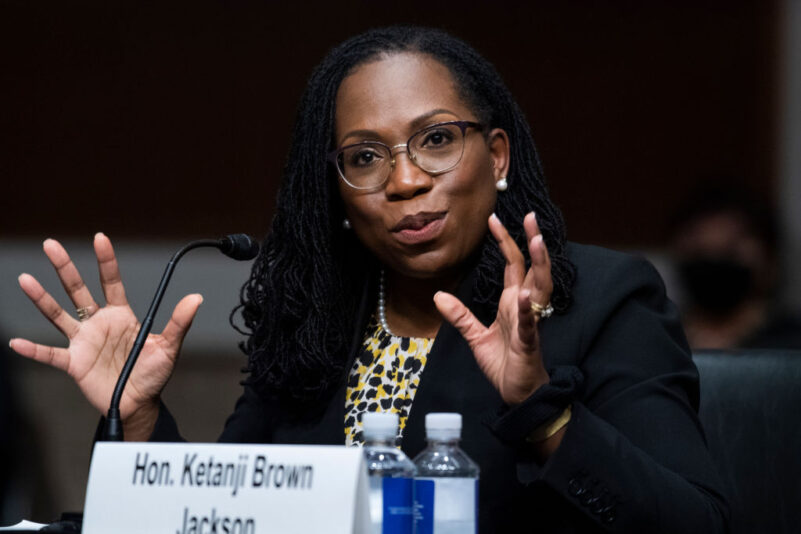
Although it isn’t a major case, the Supreme Court reversed a lower court decision that did not sit well with Joe Biden’s DEI Justice Ketanji Brown Jackson. The ruling was a 7-2 decision, which was not particularly controversial. In this instance, Justice Elena Kagan sided with the conservatives. The case involved a police stop that took place in the District of Columbia in February 2023.
“RW” believed that his rights were violated after getting pounded with a slate of charges that included “delinquent on counts of unauthorized use of a motor vehicle, felony receipt of stolen property, unlawful entry of a motor vehicle, and operating a vehicle in the District of Columbia without a permit,” according to Courthouse News Service.
The lower court initially ruled that the police lacked reasonable suspicion to stop the defendant. That decision was settled on Monday. Justice Jackson was the only dissenter, while Sotomayor opposed the ruling but did not join Jackson’s dissent.
Here are some details of the case:

In the wee hours of a winter morning in Washington, D. C., District of Columbia Metropolitan Police Officer Clifford Vanterpool received a radio dispatch call directing him to check out a suspicious vehicle at a specific address. Officer Vanterpool reached the apartment building at that address around 2:00 a.m. As he turned his marked police vehicle into the parking lot, he saw two people immediately flee from a car, “unprovoked,” after “[p]olice had not done anything other than simply pull up.” App. to Pet. for Cert. 48a. The runners left open at least one of the car doors. The driver then began to back out of the parking space, rear door still open. Officer Vanterpool decided to investigate. He parked directly behind the car, left his own vehicle, ordered the driver to put his hands up, and drew his service weapon.
This case revolves around the Fourth Amendment and what defines a legal stop and reasonable suspicion and so forth. When a police car approaches a reported vehicle behaving suspiciously—especially when two occupants flee without provocation and another attempts to back out with the doors wide open—it seems like a clear case for a reasonable stop. However, this wasn’t the consensus. Jackson, in her dissent, accused her seven colleagues of ‘wordsmithing.’ Law professor Jonathan Turley took issue with this, suggesting that Brown Jackson just might not really know what that term means, which in and of itself is brutal:
? The Supreme Court, in a summary reversal, held that police had reasonable suspicion to stop a driver after passengers fled and he began backing away, faulting the lower court for a “divide-and-conquer” analysis of the facts.
Justice Jackson was the sole dissenter. pic.twitter.com/qeBATUM68U
— SCOTUS Wire (@scotus_wire) April 20, 2026
…Jackson wrote that "I cannot fathom" how the seven justices could second-guess the lower court in rejecting the police claims. She accused her colleagues of mere "wordsmithing." Just for the record, it would be useful to review those words…
— Jonathan Turley (@JonathanTurley) April 20, 2026
…Justice Jackson (and Justice Sotomayor, who notably declined to join her dissent) felt that those facts were not sufficient for the requisite suspicion needed for the stop. That seems a tad more than "wordsmithing."
— Jonathan Turley (@JonathanTurley) April 20, 2026
Absolutely crushing.