Democrats barely had time to celebrate their sweeping midterm victories before a potentially bitter fight erupted over the future of Senate Democratic leadership.
Minnesota Sen.-elect Peggy Flanagan publicly called for Democrats to replace longtime Senate leader Chuck Schumer, arguing Tuesday’s election results showed voters want a new generation running the party.
“I am tremendously grateful for Chuck Schumer’s leadership and what he has done over the last many years,” Flanagan said Wednesday. “And I think it is time for new leadership.”
Flanagan defeated Republican Michele Tafoya in Minnesota’s open Senate race, keeping retiring Democratic Sen. Tina Smith’s seat in Democratic hands.

Her victory came during a massive Democratic night that gave the party control of both chambers of Congress and flipped at least seven Republican-held Senate seats.
But Flanagan argued the results represented something larger than a traditional partisan victory.
“One of the things that we heard last night, resoundingly, across the country is that we are in a point of a new movement in this country,” Flanagan said.
“Many of us were elected, who refused corporate PAC money, who are beholden only to the people who elected us and are ready to fight for bold change,” she added.
Flanagan did not identify a preferred replacement for Schumer.
“When it comes to exactly who that is, I can’t tell you that, but I think that people are ready for new voices and new leadership in the Senate caucus,” she said.
Flanagan is hardly alone.
Several members of Democrats’ incoming Senate class campaigned on replacing Schumer or have expressed serious reservations about keeping him atop the caucus.
Kansas Sen.-elect Adam Hamilton previously declared, “I’m not supporting Schumer for leader,” while calling for “new, younger leadership” capable of working across party lines.
Maine Sen.-elect Troy Jackson, who defeated longtime Republican Sen. Susan Collins, also reaffirmed his opposition this week.
“I’ve already said that I told Sen. Schumer that I’m gonna support somebody else,” Jackson said before Election Day. “It’s no different now.”
Illinois Sen.-elect Juliana Stratton has also said she would not support Schumer, while Michigan Sen.-elect Abdul El-Sayed said Wednesday that Democrats need new leadership but declined to endorse a specific alternative.
The opposition presents an awkward situation for Schumer after his political operation helped Democrats produce one of their strongest Senate performances in years.
Democrats are projected to control between 54 and 56 Senate seats once outstanding races are resolved, giving Schumer considerable breathing room despite defections from incoming progressives.
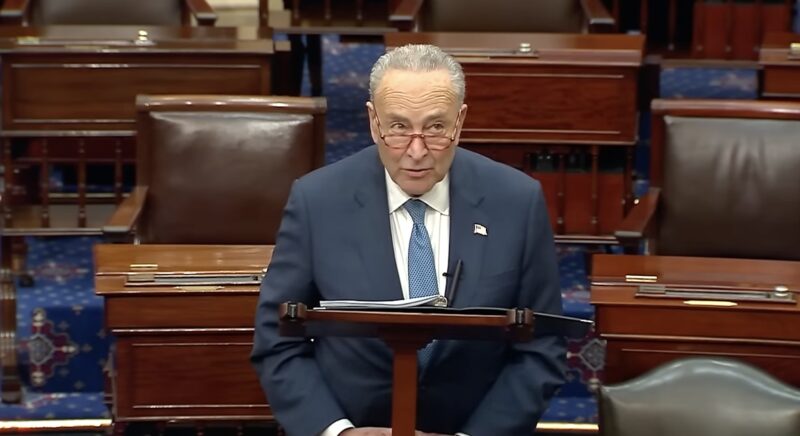
Schumer showed little concern Wednesday.
“I’ll be re-elected as majority leader,” Schumer told reporters.
“The issue is not me,” he added. “The issue is focusing on the American people and what they want.”
No sitting Democratic senator has publicly launched a challenge against Schumer, making his removal considerably more difficult.
Potential successors discussed within Democratic circles have included Sens. Chris Murphy of Connecticut, Chris Van Hollen of Maryland and Cory Booker of New Jersey, though none has announced a leadership campaign.
Schumer has led Senate Democrats since 2017 after succeeding former Nevada Sen. Harry Reid.
His standing became particularly shaky in 2025 after progressive activists blasted his handling of confrontations with President Donald Trump and congressional Republicans.
MoveOn and other progressive organizations openly called for Schumer to step aside, while Democratic lawmakers increasingly faced demands from their base for a more confrontational approach.
Schumer subsequently rebuilt significant support inside his caucus, and Democrats’ enormous 2026 Senate gains have strengthened his argument for remaining leader.
The ultimate decision will be made by Democratic senators and senators-elect through a secret-ballot leadership election.
For now, Schumer remains the overwhelming favorite.
But Democrats’ new majority will arrive in Washington containing an unusually large group of senators who openly campaigned against the man expected to lead them.