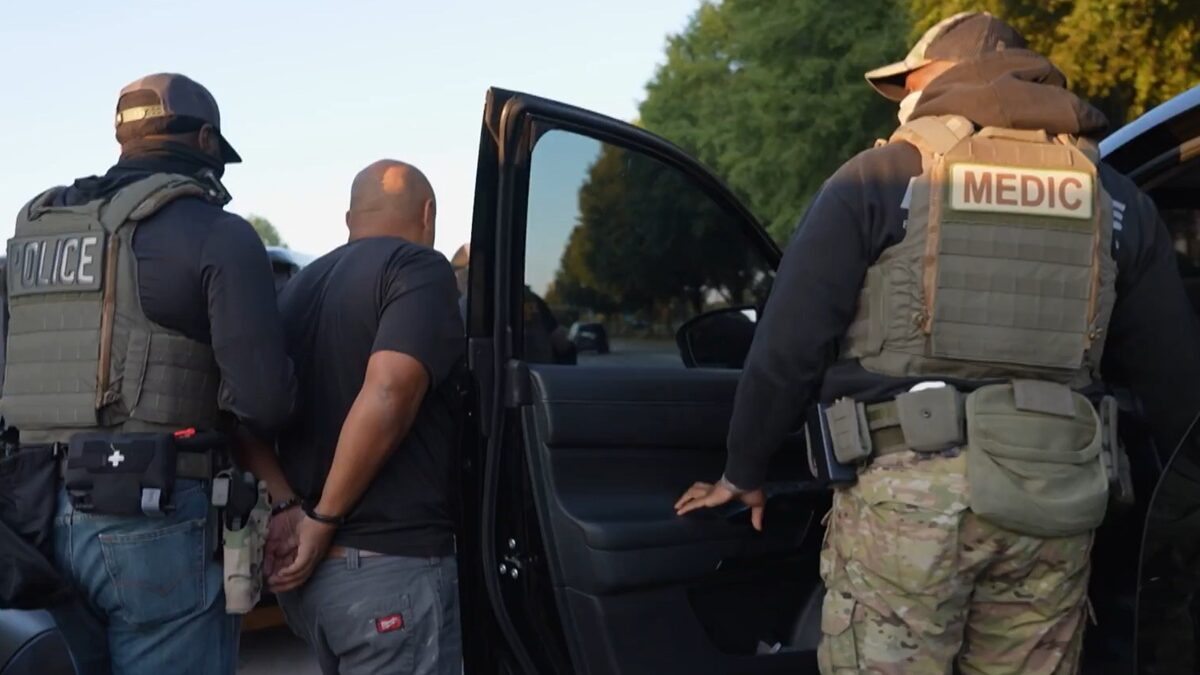
Moussa Diawara, a 57-year-old father of two U.S. citizen children who lived in suburban Houston, had a federal court order protecting him from deportation to Mali. ICE deported him to Ghana anyway this summer, and Ghana turned around and shipped him to Mali, which is exactly where the court said he couldn’t go.
Diawara came to the United States on a tourist visa at age 32 and overstayed it. He applied for refugee protection, arguing he’d be persecuted in Mali because he converted to Christianity in a Muslim-majority country dealing with an Islamist insurgency. A U.S. immigration judge agreed in 2012, issuing a withholding of removal order that blocked his deportation to Mali while allowing the U.S. to find a safe alternative country if it wanted to remove him. He had no criminal record. He worked as an Uber driver, paid taxes, and was married to Barbara, a registered nurse. His son Corey is 16. His daughter Chloe is 12.
Cool. But there’s something missing that you still don’t know. The guy came to America 25-years-ago illegally. So basically, he’s been breaking the law for 25-years and 60 Minutes casually left that out of their Twitter post. And yes, I still say Twitter. Get over it. At least I’m a real citizen.
And let’s get back to the details on this guy. ICE agents were waiting for Diawara at his home after a night shift on July 11. He spent three weeks in detention in Texas, unable to reach his lawyer or appear before a judge, then was loaded onto a deportation flight on July 30 that stopped in Sierra Leone and the Central African Republic before landing in Ghana on July 31. There were 63 people on that flight. A 60 Minutes investigation found that 17 of the 19 passengers it reached said Ghanaian officials subsequently sent them, against their will, to countries U.S. judges had ruled they couldn’t be sent to, including Mali, Niger, Nigeria, Gambia, and Guinea.

In Ghana, Diawara said he was held in a hotel by armed guards with no phone access. “I cannot call my wife, I can’t contact my lawyer. I can’t talk to no one,” he said. “I tell them, ‘This is kidnapping. You guys kidnapped us.'” Within days, Ghanaian officials put him on a flight to Mali, the one place a federal judge had specifically ordered the U.S. not to send him.
Here is where it gets interesting. The medical document Diawara received on his flight to Ghana listed the destination as “SHRC Mali.” Both of his DHS-issued bag tags also listed Mali as the destination. When asked about it, third-country deportation program DHS top lawyer James Percival said, “Well, he wasn’t flown to Mali. He was flown to Ghana, but I can’t speak to why that piece of paper says that.” A DHS spokesperson later called the medication form a “clerical error” and said the bag tags were produced by contractors not involved in determining destinations. Ghana’s government declined to comment.
Percival said he’s not aware of any cases of Ghana sending deportees to other countries against their will. He did suggest that some deportees might “choose to go home” and “not always be truthful about the fact that they consented.” Video footage released last year shows Ghanaian officials physically dragging Rabbiatu Kuyateh, a nurse who lived in the U.S. for 30 years, onto a flight back to Sierra Leone. She also had a withholding of removal order. So, you know, there’s that.
Of the 63 people on Diawara’s flight, a 60 Minutes review found 62% had no criminal record at all, 19% had only a traffic violation, and 19% had been charged with or convicted of crimes including theft, assault, drugs, or weapons possession. Percival said Diawara’s flight was part of a broader operation where ICE has deported 25,000 people to dozens of third countries, which receive millions in U.S. aid in exchange. A federal appeals court ruled last month that the third-country deportation policy violates due process, but the Supreme Court is letting the program continue until it hears the case in December.
Diawara eventually escaped Mali with help from local truckers and made it to a third country, which he asked not be named for his safety. He’s hiding there now, thousands of miles from his family. His attorney, Reuben S. Kerben, has asked a federal judge in Washington, D.C., to order Diawara returned to the U.S. Back in Texas, his wife Barbara is holding the family together. “It feels really empty without him,” his son Corey said. The Supreme Court will take up the administration’s third-country deportation policy in December, and that ruling will likely determine whether Diawara and others in his situation ever make it home. Either way, someone at DHS is going to have a very hard time explaining those bag tags.
Now that you’re done with the sob story, can I remind you that the guy came to America illegally? He came to America illegally and got deported 25-years-later.
Am I supposed to feel bad?
Here’s what 60 Minutes posted on X and the comment section DID NOT DISAPPOINT!
He was basically on the run for 25 years considering be broke into the country illegally.
Duh.
— Frank (@drastic215x) October 26, 2026