Getting a Supreme Court justice confirmed to the nation’s highest bench is a tall order these days. The hyper-partisanship makes each nominee a crap shoot in many cases, especially if the president doing the nominating is Donald Trump.
Right now, before the new Congress is sworn in come January 2027, it’s a safe bet that at least four ‘Republican’ senators would vote with Democrats to keep anyone he picks off the Supreme Court. Names? McConnell (if he even survives that long). Tillis. Cassidy. Murkowski. Collins? Maybe, but she’s got a tough reelection coming up.
With all that said, Trump moved heaven and earth to get a couple of his nominees to the high court. Brett Kavanaugh’s confirmation hearing was a sick demonstration of just how low the Domestic Terrorist Party will sink (fabricated rape charges from several ‘victims’ and witnesses, all of whom lied and got away with it) to keep a conservative constitutionalist off the bench.
Then came Amy Coney Barrett. Again, Trump moved heaven and earth to get this supposedly conservative, Catholic woman onto the bench. And if anything, she’s had a mixed record of constitutionally sound opinions. She just screwed us again – her and John Roberts – over mail-in ballots. ACB wrote the opinion that said, essentially, Election Day, as recognized since the mid-1800s up until the early 2000s, was a single day to vote and have ballots count/be counted, is no longer the case. No, ballots can be received and counted days later if they have a pre-election-day postmark. Groan.
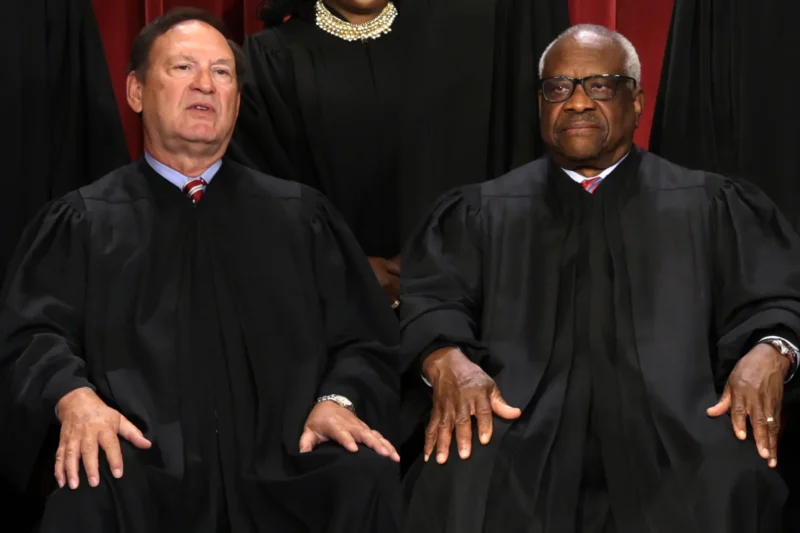
Well, one justice on the court who has been a staunch constitutionalist since his first day there, Samuel Alito, has had enough of this wishy-washy constitutional interpretation from ACB and Roberts, who joined the court’s three libs to uphold Mississippi’s law allowing ballots to be received up to five days after Election Day, provided they are postmarked ahead of election day.
He wrote a scathing dissent in the case, Watson v. Republican National Committee:
Alito argued that the whole idea runs contrary to the nation’s long history of Election Day and raises serious concerns about undermining trust in American elections. He also criticized the Court for failing to maintain systemic barriers that provide an added check against election fraud.
“From this Nation’s founding until the last few decades of the 20th century—a period that spans the enactment of all three election-day statutes—having an ‘election’ on a particular day meant completing ballot collection on that day,” he wrote.
Alito argued that Election Day has always been November 3, establishing it as the definitive cutoff for voting. He contended that counting ballots after this date effectively extends the election beyond the designated timeframe, conflicting with the rules set by Congress. He also stated that not ensuring mail-in ballots are counted by Election Day weakens safeguards against election fraud and further undermines the integrity and trust in American elections.
“Not only is today’s decision inconsistent with statutory text, legal context, historical practice, and precedent; it also threatens to produce lamentable consequences,” Alito wrote. “The majority’s holding spawns a slurry of troubling election-law questions and risks further undermining Americans’ confidence in election integrity.”
“By allowing States to continue receiving new ballots during these drawn-out processes, today’s decision will only exacerbate voters’ distrust,” he wrote.
“It is undeniable that a prohibition on counting late-arriving ballots would provide an additional hurdle for bad actors seeking to stuff ballot boxes when early election results suggest a tight race. The majority incorrectly removes this safeguard from federal law,” he added.
“Today’s decision is inconsistent with the terms of the election-day statutes, contemporary election-law principles, two centuries of historical practice, and the case law on the question presented,” Justice Alito concluded. “It opens up and fails to resolve a host of questions for state election officials and courts. And it creates a serious risk of further undermining public confidence in our elections and our system of self-government. I therefore respectfully dissent.”
But, eh, meh – nothing to see here, sayth Barrett and Roberts.
Trump spent a ton of political capital on both Kavanaugh and ACB. For all that trouble, he’s only getting a 50 percent return on the investment. Pathetic.