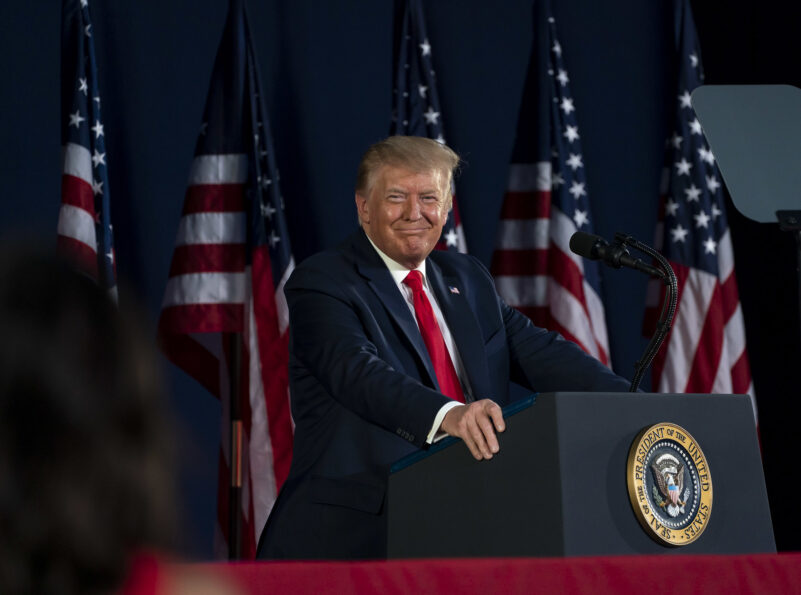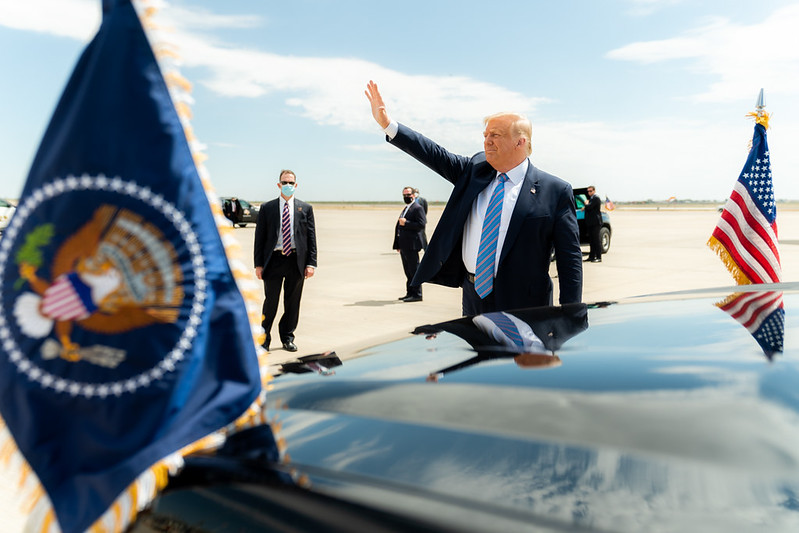
Over the holiday weekend, President Trump posted four words to Truth Social — “the moon is ours” — and the internet did what the internet does. Prediction markets floated headlines about the U.S. annexing the lunar surface. Supporters cheered. Critics scoffed.
This claim is a violation of the Outer Space Treaty. @UN
“outer space is not subject to national appropriation by claim of sovereignty, by means of use or occupation, or by any other means”https://t.co/VWupkatmtm
— ?????? Rachel McEvoy ?????? (@RachelMcEvoy8) September 6, 2026
Because he says so?
The old man is suffering from dementia. He's confused, delusional, & paranoid. He needs to be kept calm, & med's increased. The fact that you all encourage his delusional behavior is just cruel, shame on you! The man is clearly suffering.— ??????? – I am antifa. I'm against fascism (@Psyched55) September 6, 2026
Damn. The stupidity never stops. Isn’t it hard to keep one -upping for the most stupid posts of the day?
— David Thornton (PilotPundit) ????? ?? (@captainkudzu) September 6, 2026

Lost in the noise was the fact that the throwaway line sits on top of the most concrete American space push in a generation, and the policy is the part worth paying attention to.
— Republicans (@Republicans) September 6, 2026
Start with what’s real, because it’s easy to miss under the theater. On August 28, Trump signed an executive order establishing a United States Space Academy — a dedicated pipeline to train the next generation of astronauts, engineers, operators, and, pointedly, warfighters to feed the Space Force and NASA. The stated rationale was straightforward: if America intends to lead in space and defend its interests there, it has to build the workforce to do it. That’s not a tweet. That’s an institution, modeled on the service academies, aimed at a domain the country spent decades treating as an afterthought.
President Trump signs executive order creating U.S. Space Academy. pic.twitter.com/UjJKjcxGPR
— CSPAN (@cspan) August 28, 2026
Pair that with the other half of the agenda. Trump honored the Artemis II crew and signed a commemorative plaque the astronauts will carry to the lunar surface — one that marks not just a return to the Moon but the planned beginning of a permanent human presence there. Back in March, the White House stated the goal plainly: not to visit the Moon, but to stay. Read against that backdrop, “the moon is ours” stops being a boast about annexation and starts reading as what it plainly is — shorthand for a national commitment to get there first and remain.
The Boss is on fire today. Trust and believe. No Panicans!! America is #1!! ? https://t.co/FwvOb8vyOl pic.twitter.com/FkyQPqDLCE
— Fashionably_T ?? (@Fashionably84) September 6, 2026
And “first” is the operative word, because this isn’t a solo race. China has openly declared its own intention to put humans on the Moon and build a permanent base, and its program is state-driven, well-funded, and explicitly tied to national prestige and strategic positioning. Whoever establishes a durable presence — near the water ice at the lunar south pole, along the orbital high ground — sets the terms others have to live with. That is the real stakes behind the meme, and it’s why a Space Academy and a “we’re staying” posture are more than symbolism. They’re an answer to a competitor who is entirely serious.
The honest caveat: the Outer Space Treaty bars any nation from claiming sovereignty over the Moon, so “the moon is ours” is not, and cannot be, a literal territorial claim, and critics who read it that way are arguing with a slogan rather than a policy. Establishing presence and capability is the game that’s actually being played, and it’s a legitimate one.
So let the prediction markets have their fun. Underneath the viral three words is a coherent bet: that space is contested territory, that the workforce and the foothold go to whoever commits first, and that America intends to be that nation. The meme will fade. The academy won’t.