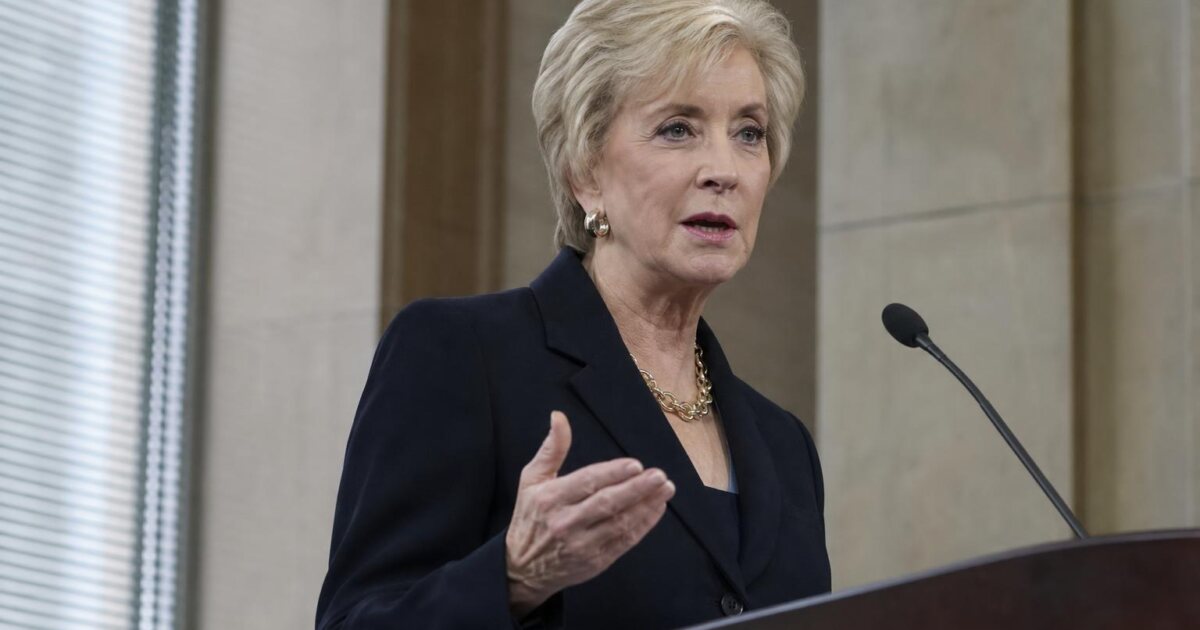
The U.S. Department of Education has formally rescinded the Biden administration’s 2024 Title IX rule, Education Secretary Linda McMahon announced. The action restores the 2020 regulatory text that was in place under the first Trump administration and reinforces the position that girls’ and women’s sports should be limited to female athletes.
It was designed for real females, not males dressed up in women’s clothes.
“We’re just acknowledging that boys and men are in boys and men’s sports and girls are in theirs,” McMahon said. Courts had already struck down the Biden rule before the announcement, and the department had stated in January 2025 that it would enforce the earlier Trump-era regulations in the meantime.
What the Formal Rescission Changes
McMahon said the step is primarily about clarity, even though enforcement of the older rules was already underway. “Well, it just gives clarification to students, teachers, schools, parents,” she said. “Everyone now knows what the rule is and how everyone is going to abide by it.”

The Biden administration’s 2024 rule had expanded Title IX’s sex-discrimination protections to cover gender identity. A separate Biden-era proposal that would have addressed athletic eligibility directly was withdrawn in December 2024. McMahon argued the rescission brings the statute back to its original purpose. “Title IX was set up to give everyone, including women, equal opportunity to sports. And then under the Biden regulations, many of those rights had been taken away,” she said. As part of Title IX rule enforcement and rescission, the departments of Education and Justice had already launched a Title IX Special Investigations Team in April 2025, and the federal government filed a lawsuit against Maine over its policy allowing transgender-identifying males to compete in girls’ sports.
Consequences for States Resisting the Rules
Asked about states including Maine, California and Minnesota that have not aligned with the administration’s interpretation, McMahon pointed to financial accountability measures for funding recipients classified as high risk. “What that means is that they don’t get their funding in advance. They have to produce receipts to us,” she said. “We therefore can confirm that they are spending the money in ways that it should be spent.”
She also cited the Maine case referral to the Justice Department as an example of further consequences available to the federal government. “So there are many kinds of consequences that can come to states and schools that are not abiding by Title IX,” she said. On June 30, 2026, the Supreme Court upheld Idaho and West Virginia laws restricting girls’ sports to females, lending additional legal weight to the administration’s position.
Remedies for Female Athletes and What Comes Next
McMahon pointed to the University of Pennsylvania’s agreement with her department as a model for addressing athletes who already lost records or titles. That agreement, which followed swimmer Lia Thomas’ participation on the women’s team, required Penn to restore records and titles and issue apologies. “Not only were apologies extended, but the titles were then given to the women who had rightfully won,” McMahon said.
She said the department would evaluate future cases individually rather than apply the Penn framework universally. For parents of daughters placed in competition with or in locker rooms alongside male athletes, McMahon advised contacting school officials and reporting the situation to federal authorities, though she did not specify a timeline for intervention. When asked about the broader legal path forward, she returned to the statute itself. “It is Title IX. That is exactly why Title IX was established,” she said. “It is in law, it exists, it’s a statute, and it should be obeyed.”