
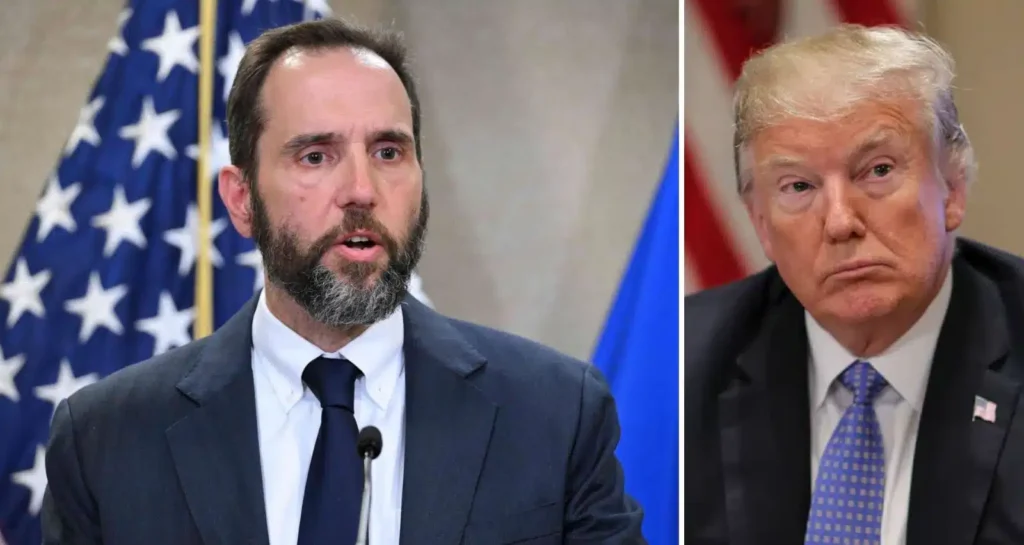
Thursday was an absolute train wreck for former Special Counsel Jack Smith — a shambolic, humiliating display that exposed exactly what his so-called investigations into Donald Trump really were: a naked political operation disguised as law enforcement.
What unfolded before the House Judiciary Committee was part accountability session, part demolition.
Republicans rightly came swinging, dismantling the façade of legitimacy around what history will remember as one of the most reckless witch hunts ever launched against a presidential candidate. Democrats, on the other hand, did what they always do in these moments: defended the indefensible with apologies, hand-wringing, and the usual nauseating theatrics.
But the most devastating blow didn’t come from Republicans. It came from CNN’s own top legal analyst, former federal prosecutor Elie Honig.
And that’s what made it fatal. Honig zeroed in on the moment that gave the entire game away: Jack Smith’s timeline. Smith wanted a trial — involving 13 million documents — rushed into court within five months. And Smith didn’t even bring it up because that was the truth:
Even CNN is now turning on Jack Smith after his House Judiciary testimony.
CNN legal analyst Elie Honig zeroed in on the moment Republicans cornered Smith over rushing the Trump case right before the 2024 election — and Smith had no answer.
HONIG: “To your question, Brianna,… pic.twitter.com/JgLUKrU4nK
— Overton (@overton_news) January 22, 2026
To your question, Brianna, the last Congressman we saw brought up the fact that Jack Smith demanded a trial date four months out, five months out in a case involving 13 million pages of documents. There is no defense lawyer in the country who can constitutionally prepare for trial and defend his client on that short of time frame.
The implication was you were rushing to get this in before the 2024 election. Jack Smith did not defend himself, by the way. He didn’t say a word about that, which I found, I found striking. And Jack Smith has always maintained this veneer that he never thought about the election…of course he did. Why would would you demand such a quick trial date.
Honig criticized Smith for attempting to create a 2024 October surprise with that desperate filing against Donald Trump, which seems like a last-ditch effort to make some progress on the lawfare front:
Enjoying our conservative news and commentary? Make sure you share and tell your friends about us!
Smith has essentially abandoned any pretense; he’ll bend any rule, switch up on any practice — so long as he gets to chip away at Trump’s electoral prospects. At this point, there’s simply no defending Smith’s conduct on any sort of principled or institutional basis. “But we need to know this stuff before we vote!” is a nice bumper sticker, but it’s neither a response to nor an excuse for Smith’s unprincipled, norm-breaking practice. (It also overlooks the fact that the Justice Department bears responsibility for taking over two and a half years to indict in the first place.)
Let’s go through the problems with what Smith has done here.
First, this is backward. The way motions work — under the federal rules, and consistent with common sense — is that the prosecutor files an indictment; the defense makes motions (to dismiss charges, to suppress evidence, or what have you); and then the prosecution responds to those motions. Makes sense, right? It’s worked for hundreds of years in our courts.
Not here. Not when there’s an election right around the corner and dwindling opportunity to make a dent. So Smith turned the well-established, thoroughly uncontroversial rules of criminal procedure on their head and asked Judge Chutkan for permission to file first — even with no actual defense motion pending. Trump’s team objected, and the judge acknowledged that Smith’s request to file first was “procedurally irregular” — moments before she ruled in Smith’s favor, as she’s done at virtually every consequential turn.
Which brings us to the second point: Smith’s proactive filing is prejudicial to Trump, legally and politically. It’s ironic. Smith has complained throughout the case that Trump’s words might taint the jury pool. Accordingly, the special counsel requested a gag order that was so preposterously broad that even Judge Chutkan slimmed it down considerably (and the Court of Appeals narrowed it further after that).
Yet Smith now uses grand-jury testimony (which ordinarily remains secret at this stage) and drafts up a tidy 165-page document that contains all manner of damaging statements about a criminal defendant, made outside of a trial setting and without being subjected to the rules of evidence or cross-examination, and files it publicly, generating national headlines. You know who’ll see those allegations? The voters, sure — and also members of the jury pool.
And that brings us to our final point: Smith’s conduct here violates core DOJ principle and policy. The Justice Manual — DOJ’s internal bible, essentially — contains a section titled “Actions That May Have an Impact on the Election.” Now: Does Smith’s filing qualify? May it have an impact on the election? Of course. So what does the rule tell us? “Federal prosecutors … may never select the timing of any action, including investigative steps, criminal charges, or statements, for the purpose of affecting any election.
But the whole thing failed miserably, and now that Trump won the presidency again, it is buried. Good riddance.
Now, if only Republicans had the courage to make a criminal referral to the DOJ if they find something on Smith…


