
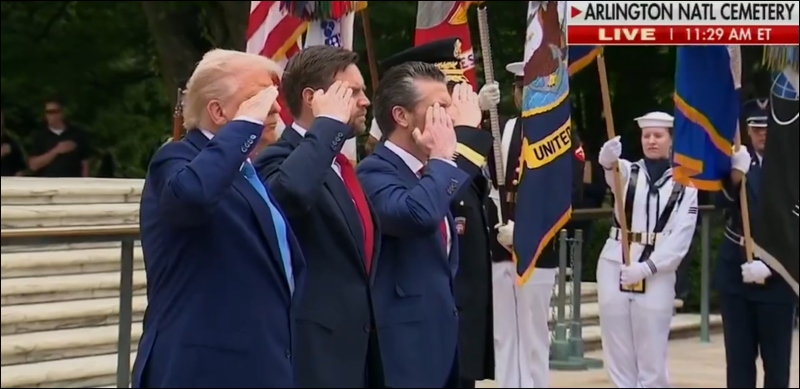
You can say a lot of things about President Donald Trump, but the one thing you cannot say is that he hates America (you can’t say the same for Democrats, though).
It has been 35 years since the United States first heard the now-familiar warning of a 12-year deadline to avert climate catastrophe—and then spent decades as one of the few industrialized nations to take it seriously. Now, as the third such 12-year countdown since the UN’s global-warming pact ticks away, Donald Trump has moved to withdraw from the agreement altogether, along with dozens of international organizations tethered to the UN’s climate bureaucracy.
This topic is more about international agreements in general rather than specifically about climate change, particularly those that tend to benefit China at the expense of American interests. And this is, at least, what drove many Trump supporters to cast their votes.
Enjoying our conservative reporting and commentary? Make sure to share and tell your friends about us!
Naturally, this could ultimately lead to legal proceedings. Unlike other executive agreements, such as the JCPOA deal with Iran, the UNFCCC was actually ratified by the Senate. Do presidents have the power to revoke ratified treaties? The Constitution does not clarify this, and the rarity of the situation means that there are few, if any, precedents to guide the resolution. This could complicate fully severing the US’s ties to the treaty, but Trump’s executive order prepares for this with the phrase “to the extent permitted by law.”
What would fall under “permitted by law”? Any solid commitment outlined in the treaty itself would likely necessitate adherence. However, the UNFCCC serves more as a framework than as a regulatory document. The subsequent agreements that stemmed from the UNFCCC, like the Kyoto and Paris accords, mandated specific decreases in carbon emissions and other measures.
Since those agreements were never approved by the US Senate, they occupy a similar uncertain status as the JCPOA, functioning as an executive agreement rather than a treaty. We have effectively dismissed the subsequent protocols established under the UNFCCC, so we have primarily conformed to the tentative and non-binding “requirements” in the treaty’s text to take action to lower emissions of carbon dioxide, other “greenhouse gases,” and particulates… which we already address through policy at both the national and state levels.
Anyway, the most significant effect will be our exit from numerous multilateral organizations – reportedly 65 in total. This will certainly help us conserve funds just by handling those affiliations, in addition to enabling us to focus human resources on genuine priorities in trade and foreign affairs.
But of course, leave it to the left-wing media that rarely, if ever, considers “America first” to complain:
President Donald Trump is withdrawing the United States from the world’s overarching treaty on climate change in a move that escalates his attempts to reverse years of global negotiations toward addressing rising temperatures.
The announcement to sever ties with the U.N. Framework Convention on Climate Change came as Trump quit dozens of international organizations that the White House said no longer serve U.S. interests by promoting what it called radical climate policies and other issues.
Trump has pressured other countries to abandon their carbon-cutting measures, and the move appears to be his latest attempt to destabilize global climate cooperation.
The 1992 UNFCCC serves as the international structure for efforts by 198 countries to slow the rate of rising climate pollution. It has universal participation. The U.S. was the first industrialized nation to join the treaty following its ratification under former President George H.W. Bush — and it will be the only nation ever to leave it.
“Destabilize global climate cooperation.” Seriously? After decades of false doom-and-gloom world is ending ‘predictions,’ this is the best the left has?
Well, Secretary of State Marco Rubio defended against the criticism from the Left regarding the termination of this and other international agreements that place U.S. policy under the influence of international organizations:
Rubio, the US secretary of state, said the organisations were driven by “progressive ideology” and were actively seeking to “constrain American sovereignty”.
“From DEI (Diversity, Equity, and Inclusion) mandates to ‘gender equity’ campaigns to climate orthodoxy, many international organisations now serve a globalist project,” he said.
That is exactly what Trump promised—repeatedly, across all three of his campaigns. And there should be no confusion: this is precisely what his supporters voted for.


