
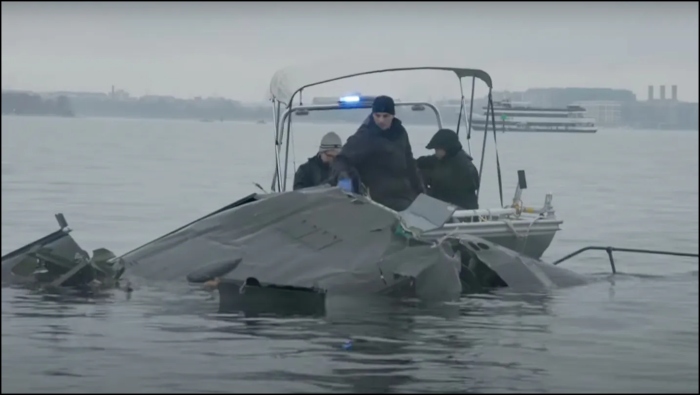
It has been almost a year since a U.S. Army UH-60 Black Hawk helicopter collided with a passenger jet while approaching Ronald Reagan Washington National Airport. This tragic incident resulted in both aircraft plunging into the icy Potomac River below. The crash, which occurred on January 29, 2025, claimed the lives of 67 individuals—64 aboard the American Airlines flight and three Army personnel aboard the Black Hawk. The first lawsuit related to this disaster is currently making its way through the courts.
Rachel Crafton, the widow of Casey Crafton, a passenger on American Airlines flight 5342 (AE5342), is taking legal action against both the airline and the U.S. government following her husband’s “senseless and tragic” death. In a court filing submitted on Wednesday, the government acknowledged its failure to meet its “duty of care” to the commercial passengers, indicating that the Army helicopter pilots did not maintain the necessary vigilance to see and avoid AE5342:
… the United States admits that the [Black Hawk] and AE5342 pilots failed to maintain vigilance so as to see and avoid each other; the DCA local controller did not comply with ¶ 7-2-1(a)(2)(d) of FAA Order JO 7110.65AA, chg. 3, Air Traffic Control (Sept. 5, 2024); and because of the [Black Hawk] pilots’ failure to maintain vigilance so as to see and avoid AE5342, the United States is liable to a Plaintiff who is legally eligible to recover certain monetary damages, as permitted by the Federal Tort Claims Act (FTCA), 28 U.S.C. §§ 1346(b), 2671–80, in an amount yet to be determined and apportioned among other tortfeasors.
The Army Black Hawk helicopter was conducting a training mission out of Fort Belvoir, Virginia, flying north along the Potomac River. As it was returning from its mission, early reports indicated that it failed to maintain the proper altitude while approaching the airport, putting it on a potential collision course with a passenger jet arriving from Wichita, Kansas.
Enjoying USA Journal’s conservative views and news? Tell your friends about us!
At a briefing earlier this year, Jennifer Homendy, the chairman of the National Transportation Safety Board (NTSB), emphasized that investigators are closely examining the altitudes of both aircraft at the moment of the crash.
The altitudes of the two aircraft on their collision course were confirmed by Homendy. Just before the crash, as the passenger jet was descending toward Reagan National, it was at 313 feet, while the Black Hawk was at 278 feet at the moment of impact.
The primary concern, aside from the unresolved questions regarding the flying experience of the female Black Hawk pilot, revolves around the altitude at which the helicopter was operating during the collision. It was mandated to maintain an altitude no higher than 200 feet as it neared the airport; however, preliminary findings from the NTSB indicate that it was flying 78 feet above that limit. This put it alarmingly close to the American Airlines flight.
While the NTSB has yet to reach a definitive conclusion about who is responsible, it is evident that the U.S. government believes there is sufficient evidence suggesting that the Army crew did not fulfill their obligation to remain vigilant during the flight. Crafton’s legal team has welcomed this acknowledgement.
“In a very carefully drafted and lengthy legal filing, the United States admits the Army’s responsibility for the needless loss of life in the crash of an Army helicopter and American Airlines Flight 5342 at Reagan National Airport, as well as the FAA’s failure to follow air traffic control procedure,” Robert A. Clifford, Crafton’s attorney, said in a statement to The Hill.
The NTSB’s final report is expected sometime early next year.


