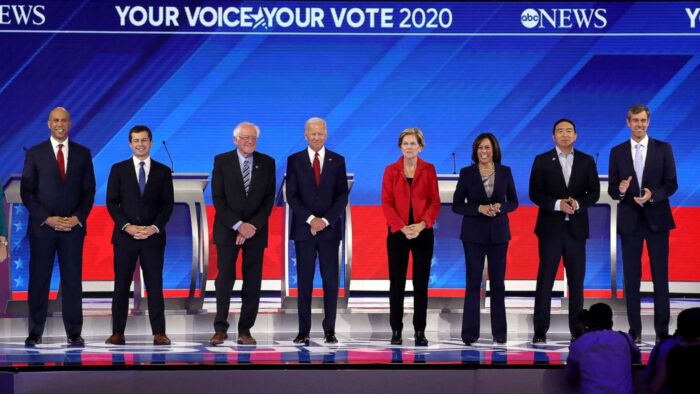
Democrats are rolling out sweeping new rules for their 2028 presidential debates, requiring candidates to denounce certain outside spending while promising a larger role for social media creators and influencers.
The Democratic National Committee announced Monday that it plans to hold 12 presidential primary debates beginning in June 2027 and continuing through March 2028.
Five debates are planned for 2027, followed by seven during the presidential election year. Candidates hoping to participate will have to sign the DNC’s new Presidential Primary Fair Campaign Practices Pledge.
The pledge requires candidates to denounce qualifying spending by super PACs and so-called dark-money organizations that promotes their candidacy or attacks their Democratic opponents.

“In the wake of the Citizens United Supreme Court decision, dark money and independent spending have exploded, increasing the influence of special interests in politics,” the DNC said.
“While the DNC does not have the legal authority to ban super PACs or dark money groups, we are requiring our candidates to denounce their involvement in the Democratic presidential primary, in line with Democratic Party values and our 2024 Platform, in order to qualify for the debate stage,” the party’s announcement continued.
The requirement applies to qualifying advertising from super PACs and 501(c)(4) organizations, including television, radio, digital, billboard and mail advertising.
The rules create an unusual situation because candidates could be required to publicly denounce advertising intended to help them even when their campaigns had no involvement in creating or financing it.
If an outside organization independently runs an advertisement supporting a candidate, that candidate must denounce the spending to remain compliant.
Candidates must also denounce qualifying advertisements attacking their Democratic opponents. The DNC plans to establish a reporting and adjudication system to enforce the rules.
Each presidential campaign will designate a representative responsible for submitting complaints and receiving notifications from the party.
The DNC will evaluate complaints before each debate qualification deadline and determine whether a candidate must issue a denunciation or take another corrective action.
A public online tracker will display complaints, their status and candidate denunciations. The rules are different when Democratic Party committees themselves are involved. Candidates cannot enter joint fundraising agreements with Democratic Party committees until becoming the presumptive nominee.
They also cannot request or approve certain advertising expenditures from state, county or other local Democratic committees during the primary.
If a campaign improperly approves such spending, it must reimburse the committee and provide proof of the refund.
The restrictions apply only to the Democratic primary and will expire for the eventual nominee during the general election.
The DNC is also planning significant changes to how the debates are presented. The party said it intends to incorporate “creators and influencers into the debate process” as part of an effort to maximize viewership.
The DNC has not yet explained exactly what role influencers will play. Specific dates, locations and media partners for the first two debates will be announced in January.
Candidates will additionally have to satisfy polling and other measures demonstrating support, including grassroots fundraising requirements. The exact qualification thresholds will also be released in January.
With Democrats potentially facing a large presidential field, the DNC said early debates could be divided across two nights. No more than 20 candidates would participate across the two nights, with qualifying candidates randomly assigned to ensure comparable lineups.
Candidates will be permitted to participate in town halls, forums and similar events where only one presidential hopeful appears at a time.
They will not, however, be allowed to participate in unauthorized events where multiple candidates share a stage and answer questions. Doing so could make a candidate ineligible for subsequent DNC debates.
DNC Chairman Ken Martin described the framework as an attempt to produce a fair primary while preparing the eventual nominee for the general election.
“The fair and transparent process and experienced leadership team we’re announcing today will keep our party united, strengthen our eventual nominee, and put Democrats in position to take back the White House,” Martin said.