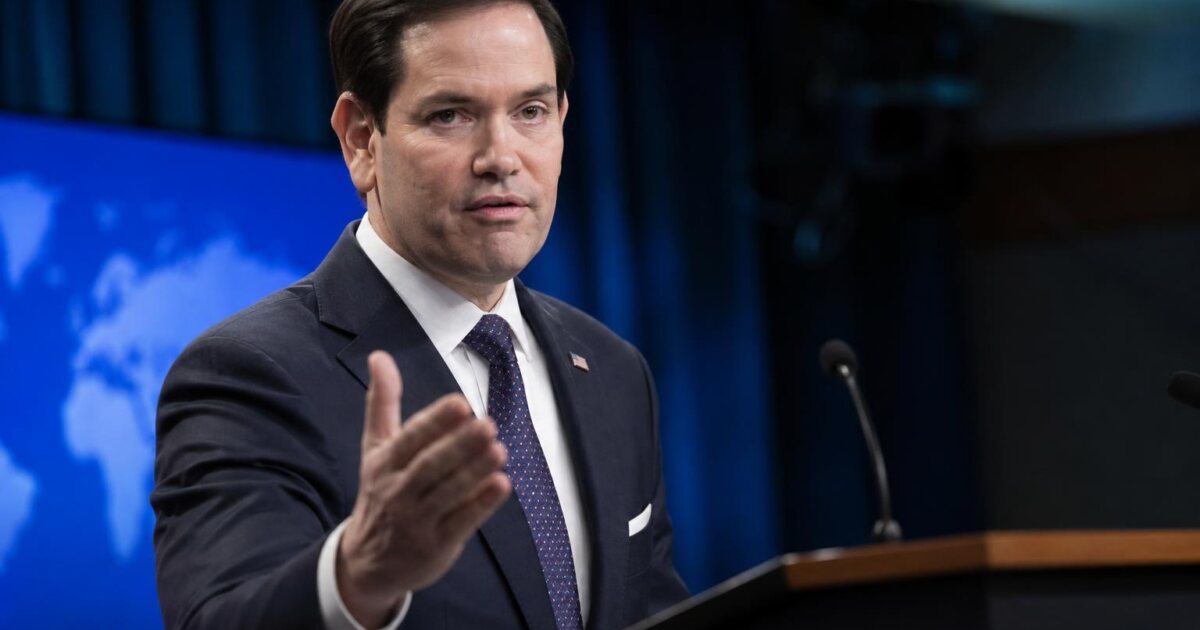
Secretary of State Marco Rubio said Tuesday that the United States remains open to diplomacy with Iran but warned that Tehran’s demands for ending the conflict remain unacceptable and unrealistic.
Speaking in Paris following two days of meetings with G7 foreign ministers, Rubio said President Donald Trump would prefer a negotiated settlement but sees little reason to accept Iran’s current conditions.
“Iran would love a deal. The problem is, the conditions they continue to place are absurd. They’re not even serious. But that could change,” Rubio said.
The secretary also argued that the Trump administration’s sanctions and naval blockade are inflicting such severe economic damage that major new American military operations are unnecessary for now.

“The economic pain that is being inflicted on Iran right now is extraordinary and it compounds. It’s growing every day,” Rubio said.
“We don’t need to conduct military strikes if we’re achieving the same objective through economic means and economic pressure. That’s not stalemate,” he added. “Never has Iran ever faced the inability to sell energy in the global market like they are today.”
Rubio told G7 allies that Washington intends to continue imposing what he described as devastating economic costs on Tehran rather than choose between accepting Iran’s conditions and immediately returning to large-scale military operations.
The game-changer in his announcement was this: “No need for major combat operations” to continue. “The economic campaign against Iran is so devastating that right now there is no need for major combat operations,” Rubio said.
The administration has imposed extensive sanctions while maintaining a naval blockade affecting Iran’s ability to export energy.
Rubio said those measures are increasingly restricting the Iranian government’s financial resources.
“Eventually, you have to eat, you have pay your own fighters, your own security forces,” Rubio said. “I think as time goes on that will have an impact.”
Iran has put forward a series of conditions for reaching an agreement with Washington.
Those demands reportedly include ending the U.S. naval blockade, lifting sanctions, releasing billions of dollars in frozen Iranian assets and paying reparations for damage caused during months of American and Israeli military operations.
Rubio flatly rejected the demand for compensation.
“They’re demanding pallets of cash, which the president made clear is not going to happen,” Rubio said.
“We’re not going to pay.”
“Iran is demanding reparations. They should be the ones paying reparations because they’re the ones that have destabilized the region.”
Iran has estimated that the conflict caused at least $270 billion in direct and indirect damage.
Tehran has shown little public indication that it intends to abandon its principal conditions.
Iranian Foreign Minister Abbas Araghchi warned over the weekend that Washington could either accept Tehran’s requirements or face continued conflict.
“American voters have made their choice. Time for the White House to make its own,” Araghchi said.
“Our 2-day proposal stands: meet the requirements, including end to war on all fronts, and you will see results. Or choose war, and see our alert and battle-hardened Warriors rain down hell.”
Rubio had already expressed pessimism about negotiations before leaving for Paris.
“You have a number of countries that continue to engage them with different ideas, but I wouldn’t say we’re on the verge of a breakthrough,” Rubio said Sunday.
“The president would always prefer to solve this and every problem diplomatically. Sometimes that’s not possible, unfortunately.”
“Right now, it hasn’t been very productive because the Iranian demands are simply not just unacceptable, but in some cases, outrageous and ridiculous, and really not realistic.”
Qatar has emerged as a key intermediary in the diplomatic effort. Qatari Prime Minister Sheikh Mohammed bin Abdulrahman Al-Thani met with Trump at the White House before making an unscheduled stop at the G7 gathering in Paris.
Regional governments have urged Trump to avoid another major escalation while negotiators attempt to establish terms for ending the conflict and reopening the Strait of Hormuz.