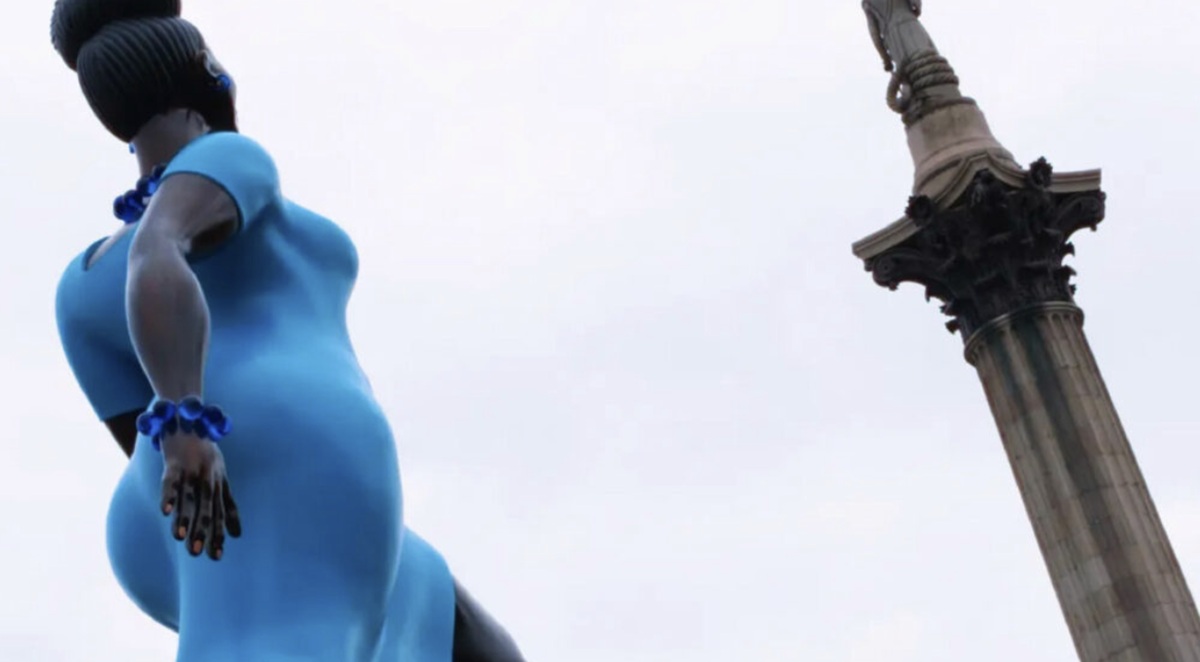
A new sculpture has arrived on Trafalgar Square’s Fourth Plinth in London, and it is generating some of the fiercest public debate and mockery the square has seen in years. The work, titled Lady in Blue, depicts a large Black woman in a skin-tight neon-blue dress striding forward, with its backers describing her as a contemporary British “everywoman.”
The statue shares the square with Nelson’s Column, completed in 1843 to honor Admiral Lord Nelson’s victory at the Battle of Trafalgar, along with long-standing statues of King George IV, Sir Henry Havelock, and Sir Charles James Napier. Critics argue that placing a figure defined primarily by her demographic characteristics alongside monuments tied to specific historical events creates a jarring and politically motivated contrast.
Sadiq Khan’s Commission and the Fourth Plinth Choice
The selection was made by the Fourth Plinth Commissioning Group, operating under London Mayor Sadiq Khan. Writer Steven Edginton, whose analysis has drawn wide attention, describes the installation as a deliberate statement rather than a neutral artistic choice. According to the Lady in Blue statue controversy, Edginton argues that the commissioners view the square’s existing figures as symbols of colonialism and a lack of diversity, and that the contrast with Lady in Blue is intentional.
“The statue is a political symbol, proudly chosen by Sadiq Khan’s Fourth Plinth Commissioning Group, meant to push their ugly vision of multiculturalism,” Edginton writes, noting that the bright, modern figure stands in deliberate opposition to the stone and bronze monuments surrounding it.
Ekow Eshun, the ‘Trojan Horse’ Remark, and the Antelope Precedent
Central to the criticism is Ekow Eshun, chairman of the group that selected Lady in Blue. Eshun previously oversaw the 2022 installation of another Fourth Plinth sculpture, Antelope, which depicted John Chilembwe, a Baptist minister who led a violent uprising against British colonial rule in Nyasaland, present-day Malawi, in 1915. Chilembwe’s followers killed two Europeans during the initial attack, including Scottish estate manager William Jervis Livingstone, who was decapitated. At the time of that unveiling, Eshun publicly celebrated Antelope as a “Trojan Horse.
Eshun has also described Britain of his childhood as “essentially a racist country” and has argued that, despite discovering one of his own ancestors was a white slave trader, he and “all black people” remain victims of the legacy of slavery. Those past statements have fueled arguments that the Fourth Plinth selections carry an agenda that extends well beyond contemporary art.
What Comes Next for the Fourth Plinth
The Fourth Plinth has rotated temporary artworks since 1999, with each commission typically lasting around two years before a new work takes its place. Lady in Blue is now the latest in that sequence, but the volume of public reaction suggests the debate over what belongs in Trafalgar Square will not end when this particular statue is eventually removed.
Critics are already calling on London’s civic authorities to establish clearer criteria for Fourth Plinth selections, ones that weigh the square’s historical setting more heavily. Whether that pressure translates into any formal change to the commissioning process remains to be seen, but the argument over who and what Britain chooses to honor in its most visible public spaces is unlikely to quiet down anytime soon.