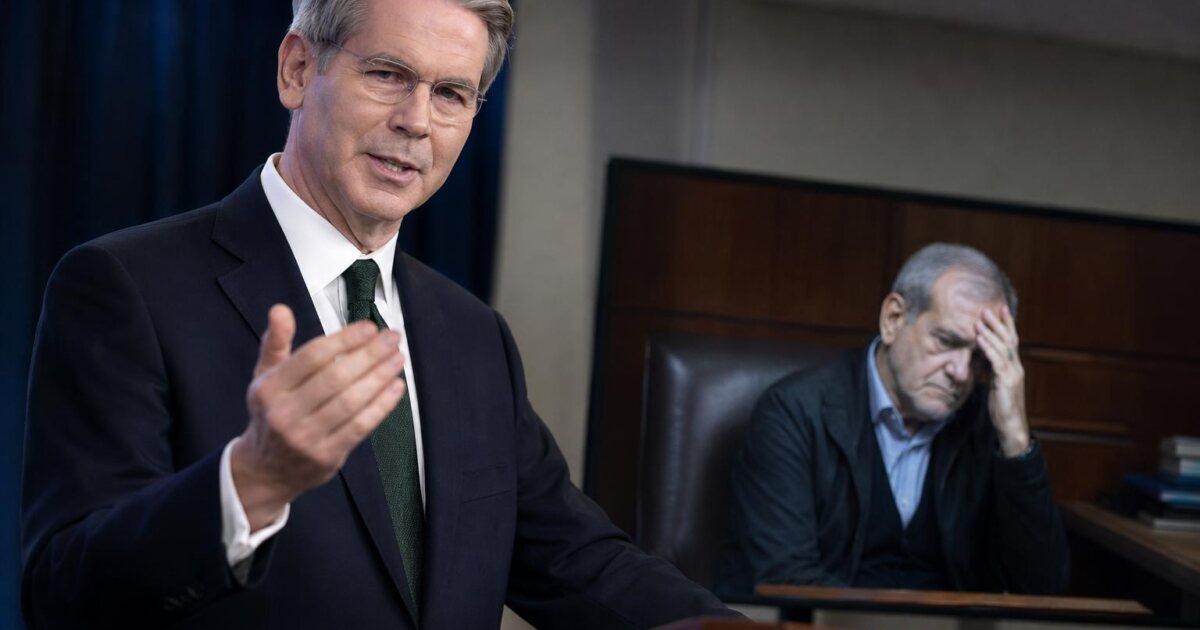
Treasury Secretary Scott Bessent has a message for the Iranian president sitting in a cold, dark office begging his own people to turn off the lights. It was seven words, and it was ice cold.
Bessent posted that gem on November 27th after Iran’s President Masoud Pezeshkian actually went on state television from his own dimly lit office, wearing a jacket, pleading with Iranians to conserve electricity. Rolling blackouts are now hitting Iran’s provinces for up to two hours a day. Long gas lines have become normal. And the regime that likes to thunder about destroying America is apparently struggling to keep the thermostat above uncomfortable. Tough look.
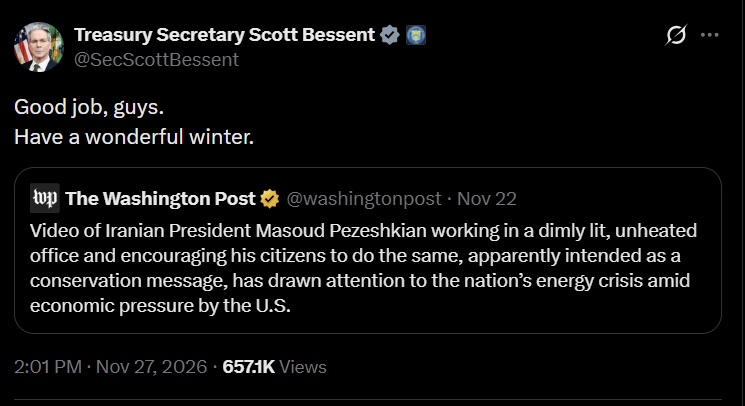
The full Bessent post, dripping with the kind of calm confidence that only comes from watching your strategy work, read: “Good job, guys. Have a wonderful winter.” That’s it. No lengthy press release. No twelve-point policy statement. Just a man who knows the scoreboard and wants the other team to know he’s reading it too. Scott Bessent Iran economic pressure The Treasury Secretary has been running Operations Economic Fury and Economic Outcast, and the results are showing up in the form of a regime that literally cannot keep the lights on.

The numbers behind that two-line tweet are brutal. The naval blockade alone has cut off nearly $4 billion per month in Iranian oil export revenue, one of the regime’s main income sources. Iran’s economy was already wobbling before the pressure campaign kicked into high gear, and now it’s in full stumble mode. Energy rationing, austerity measures, and the sight of a sitting president in a cold jacket on national TV are not signs of a government that has things under control.
Pezeshkian reportedly got blasted by regime supporters for even admitting things were rough, since showing weakness is apparently frowned upon when your whole brand is defiant revolutionary bravado. Meanwhile the regime has been making threats against Bessent and other U.S. officials, which at this point feels a little like a toddler shaking his fist from a timeout chair.
Analyst Jason Brodsky flagged the state TV video on November 20th, noting bluntly that the Iranian government “literally can’t keep the lights on and wants people to reduce consumption.” The jacket Pezeshkian was wearing suggested the heat may have been off too, which is an extraordinary visual for a government trying to project power and stability to its population.
What happens next is the question. The wrath building inside Iran toward its own government has been years in the making, and an economic squeeze this severe tends to accelerate timelines. Bessent and the broader Trump administration pressure campaign show no signs of letting up, and Iran’s options look narrower by the week. If the regime wanted a warm, comfortable winter, maybe it should have made better choices. Scott Bessent certainly isn’t losing sleep over it.