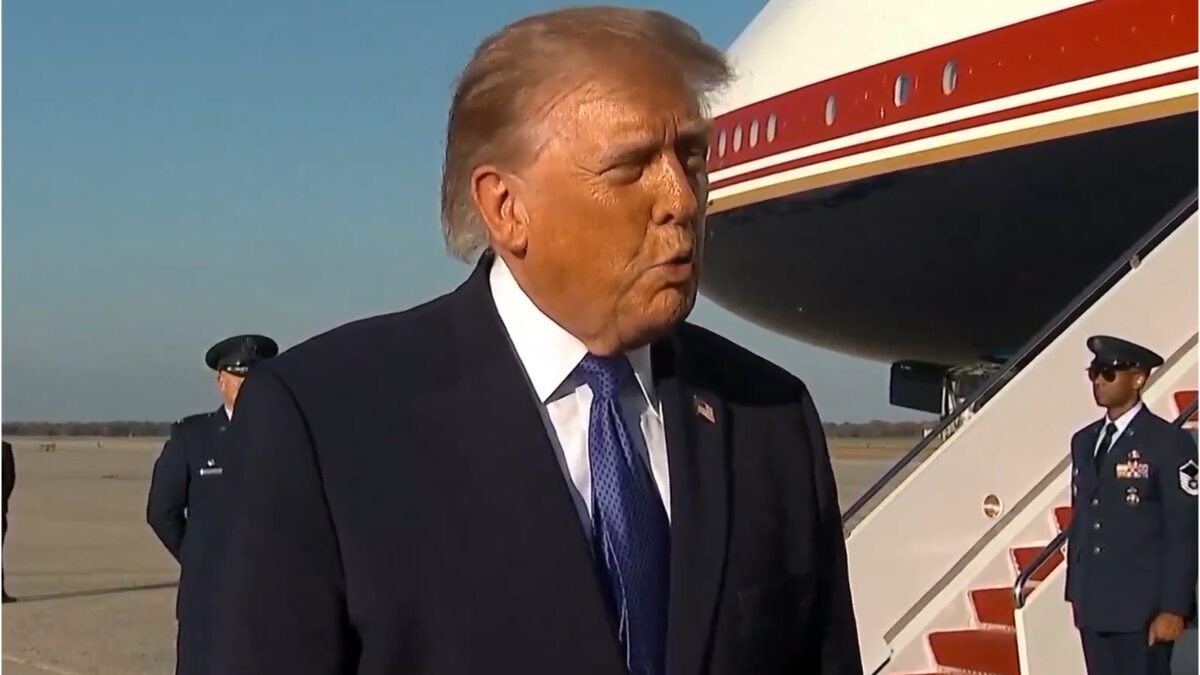
Reporters traveling with President Donald Trump were ordered to surrender their cellphones aboard Air Force One on Thursday, triggering speculation that the president might make an unannounced stop before returning to Washington.
The unusual security measure came shortly after Trump departed Shenzhen, China, following the Asia-Pacific Economic Cooperation summit and meetings with Chinese President Xi Jinping and Russian President Vladimir Putin.
“At 6:45 pm consider this your wheels up. Our phones are being taken away for now for security reasons,” Agence France-Presse White House correspondent Aurelia End wrote in a pool report. No detailed explanation was initially provided.
NBC News chief White House correspondent Garrett Haake quickly highlighted how unusual the situation was. “Pool reporters traveling with the President say that on departure, they were asked to hand over their phones (to US officials) for security reasons. This is very unusual,” Haake wrote.

Fox News senior White House correspondent Jacqui Heinrich, president of the White House Correspondents’ Association, also noted that reporters had not been subjected to the same procedure when Trump departed Beijing following an earlier China visit in May.
Heinrich pointed to another development that fueled speculation about Trump’s travel plans. A temporary flight restriction associated with a possible Air Force One refueling stop in Alaska had reportedly been removed.
“This plus pool phones being taken for security reasons raising suspicion AF1 may not be heading straight home … phones were not taken after Beijing departure in May,” Heinrich wrote. Trump’s publicly released schedule listed Joint Base Andrews in Maryland as Air Force One’s destination.
The combination of the phone restrictions and changes involving the Alaska flight restriction nevertheless prompted speculation that the president could make an unannounced detour. One possibility discussed by reporters and commentators was a meeting with North Korean leader Kim Jong Un.
Trump had repeatedly raised the possibility of meeting Kim during his Asia trip, although no meeting occurred during the APEC gathering. There was no confirmation Thursday that Trump planned to visit North Korea or meet Kim, and the White House had not announced an additional stop.
The administration later provided additional information indicating the phone collection was related to cybersecurity.
CBS News White House correspondent Jennifer Jacobs reported that an Air Force One aide collected burner phones used by White House staff and instructed reporters who had used their regular phones in China to place them inside signal-blocking bags until returning to the United States.
Trump was also asked directly about the unusual procedure during a telephone interview with NBC News. “Well, we want to be careful, and we didn’t want to have people have phones when they shouldn’t have phones, so we were very careful,” Trump said.
He did not identify a specific threat or explain whether intelligence officials had detected an attempted surveillance operation.
Security concerns surrounding electronic devices used by American officials in China are not new. During Trump’s previous visit in May, White House personnel and journalists were reportedly instructed to dispose of burner phones, credentials, lapel pins and other materials obtained or used inside China before boarding Air Force One.
American intelligence and cybersecurity officials have long warned travelers that electronic devices used in China could be vulnerable to surveillance or compromise.
Thursday’s situation attracted considerably more attention because reporters were required to surrender phones they regularly use rather than simply discard temporary equipment.
The development also followed an unusually tightly controlled summit in Shenzhen involving Trump, Xi and Putin.