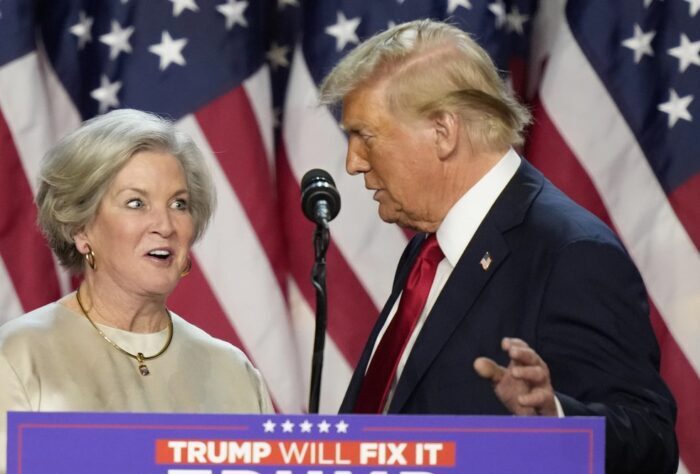
Three days after the worst Republican midterm in sixty years, Donald Trump announced that Stephen Miller will become White House chief of staff on Monday. Susie Wiles, who held the job since January 2025, moves to the Trump political operation. Her last day was Friday.
The White House statement was gracious — Trump called Wiles outstanding and thanked her for her service, and Wiles posted that serving in the White House was the honor of a lifetime and that her commitment to the president and the mission hasn’t changed. Both of those things are probably true, and Wiles earned the send-off.
Trump: Stephen Miller will replace Susie Wiles as White House chief of staff. https://t.co/QHdmu62J6j
— Philip Melanchthon Wegmann (@PhilipWegmann) November 6, 2026
Wiles posted Friday:

Today is my last day as White House Chief of Staff.
Serving President Trump in the White House has been the honor of a lifetime. I’m so proud to have been a part of what we’ve accomplished together from securing our border and cutting taxes to strengthening our economy and putting America First.
More than anything, I’m grateful for the extraordinary people I’ve had the privilege of working alongside. While my role may be changing, my commitment to the President and the mission never will.
She was, by any fair accounting, the most effective chief of staff of either Trump term. Compare the first eighteen months of this administration to the first eighteen of the last one. No Scaramucci. No leaking from four competing factions to four competing reporters. No Cabinet officials conducting policy disputes through anonymous quotes in the Times. Wiles ran a tight shop staffed by people who actually wanted the agenda to succeed, and the agenda moved: the border, the tax bill, the confirmations, the deregulation. That operational discipline was not an accident, and it was not free.
But a chief of staff’s job description changes with the circumstances, and the circumstances changed Tuesday night.
Wiles was built for governing with a friendly Congress. The skill set was managing a legislative calendar, keeping the president’s time productive, and preventing the self-inflicted wounds that defined 2017. There is no friendly Congress anymore. Come January there’s a Democratic House drawing up impeachment articles against Pete Hegseth as a warm-up act, a Democratic Senate that will confirm nothing, and a subpoena operation aimed at everyone in the building.
The next two years are not a legislative project. They are a siege. What the White House needs now is executive action that survives contact with the Ninth Circuit, personnel who don’t crack under subpoena, and a staff that understands it is going to be investigated for sport.
Miller is suited to that in a way few people in Washington are. He has been in the fight since 2015 and has never once wobbled, never leaked to improve his own press, never gone on background to explain that he was the adult in the room. He is the architect of the immigration enforcement regime that remains this administration’s most durable accomplishment, and he built it inside the executive branch precisely because Congress refused to act. That is the exact muscle the next two years require.
He also has the one quality the moment most demands: he does not care what they say about him. The coming assault will be personal, constant, and designed to make staff want out. Miller has absorbed a decade of it and shows no sign of fatigue.
The Democrats are already howling about the pick, which is itself informative. They were not howling about Wiles.
Monday the siege begins. Trump just put the most combative man he has in the office closest to the Oval.