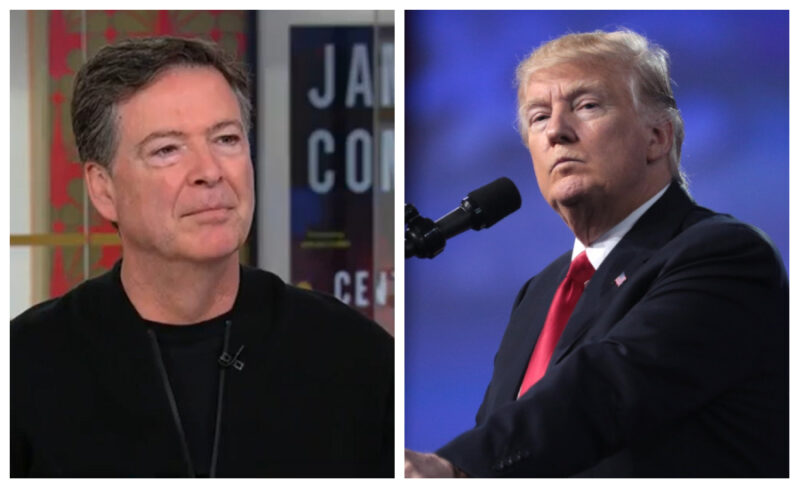
Former FBI Director James Comey is facing a third federal criminal case under President Donald Trump’s administration after prosecutors filed new charges accusing him of illegally transmitting sensitive national defense information, adding another chapter to the yearslong legal battle surrounding the former FBI chief.
Court documents made public Monday show that Comey was charged with transmitting and conspiring to transmit national defense information stemming from alleged conduct dating to October 2016, when he was serving as FBI director.
The new prosecution is separate from two previous criminal cases brought against Comey since Trump returned to office, including one involving his congressional testimony and another involving a controversial social-media post that prosecutors allege threatened the president.
Comey has denied wrongdoing and responded to the latest prosecution in a video posted to Instagram, saying the Justice Department was coming after him again and declaring, “I’m still innocent.” His attorneys have already moved to dismiss the new case, setting up another potentially contentious courtroom fight between the Justice Department and one of Trump’s most prominent longtime adversaries.

The latest indictment reportedly centers on allegations that Comey improperly transmitted national defense information in October 2016, during the final weeks of the presidential contest between Trump and Democratic nominee Hillary Clinton.
The new charges follow earlier reporting that the Justice Department had been pursuing a separate investigation into whether Comey improperly disclosed classified information while serving as FBI director.
Comey’s legal troubles under the current administration began with a September 2025 indictment in the Eastern District of Virginia alleging that he made a false statement and obstructed a congressional proceeding during testimony before the Senate Judiciary Committee in September 2020.
Prosecutors alleged that Comey falsely told senators he had not authorized another FBI employee to serve as an anonymous source in news reports concerning an FBI investigation, while Comey maintained that the charges were politically motivated and denied committing any crime.
That prosecution was dismissed after U.S. District Judge Cameron McGowan Currie concluded that Lindsey Halligan, the prosecutor who obtained the indictment, had been unlawfully appointed as interim U.S. attorney for the Eastern District of Virginia.
The Justice Department appealed the ruling, arguing that the district court misinterpreted federal appointments law and that the grand jury’s indictment should be reinstated, although a Fourth Circuit panel appeared skeptical of portions of the government’s position during arguments in September.
Comey was separately indicted in April in the Eastern District of North Carolina over an Instagram photograph showing seashells arranged to read “86 47,” which federal prosecutors allege constituted a threat against Trump, the nation’s 47th president.
That indictment charges Comey with threatening the president and transmitting a threat in interstate commerce, offenses that carry a combined maximum potential punishment of 10 years in prison if he is convicted.
Comey has disputed the government’s interpretation of the photograph and said he believed the numbers represented a political message about removing Trump from office rather than advocating violence. The Justice Department has defended the prosecution, arguing that the circumstances surrounding the post support its allegation that the message could reasonably be understood as a serious threat against Trump.
The newest case therefore gives Comey three separate fronts in his legal fight with the administration, although the status and legal issues surrounding each prosecution are different.
Trump and Comey have been bitter political adversaries since the president’s first term, when Trump fired Comey as FBI director in May 2017 amid the bureau’s investigation into Russian interference in the 2016 election.
Trump has repeatedly accused Comey and other former federal officials of abusing government power during investigations involving his campaign, and a great deal of evidence that has surfaced from various probes into the situation have essentially proven Trump correct.
The latest charges involving national defense information could prove particularly consequential because cases involving sensitive government information can raise complicated questions surrounding classification, disclosure, intent and whether the information at issue legally qualifies as national defense information.