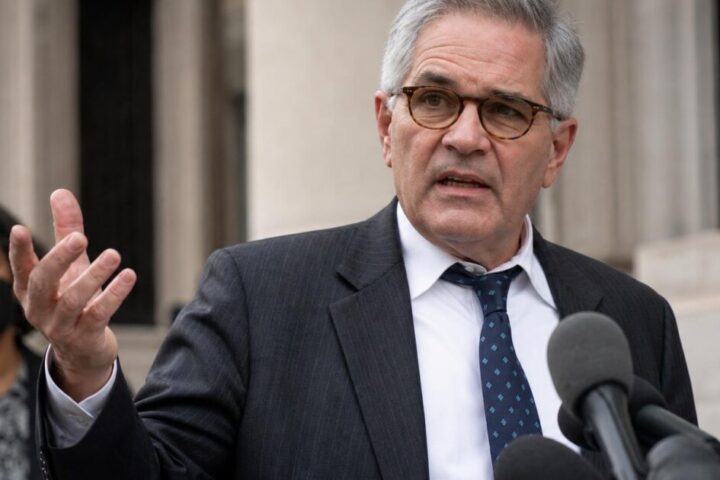
George Soros likes to use his billions to help elect left-wing, anti-American candidates to law enforcement positions so they can then use their authority to undermine the rule of law and further shred the fabric of American society. One of them is named Larry Krasner, and his district attorney domain is the city of Philadelphia, where he has made a career out of making city residents’ lives less safe.
Now, the Justice Department may be coming to the rescue. The DoJ has sent grand jury subpoenas to Krasner’s office, per Fox News and two sources familiar with the matter, concerning potential obstruction of justice in proceedings before federal judges.
This follows a referral from U.S. District Judge Paul Diamond, who last month sent Krasner and his top deputy, Matthew Stiegler, to federal authorities over allegations of false statements, perjury, obstruction, and conspiracy. Nobody has been charged, and subpoenas are not indictments.
Read what the judge actually wrote, though, because it is not the usual bureaucratic hedging. Diamond concluded — reluctantly, he said — that Philadelphia’s highest law enforcement official and one of his top assistants may have violated the law.

The underlying matter is a 2009 murder conviction. Dennis Johnson was found guilty of killing Kenyatta Smith. In 2022 Krasner’s office filed papers supporting Johnson’s habeas petition. When prosecutors on the case spotted a conflict involving Stiegler and recommended handing the matter to the Pennsylvania Attorney General, Diamond found that Krasner refused, insisting someone from his office stay involved in order to — his phrase — protect the office.
Four of his own supervisors testified he pushed them to present a misleading account to the court, and that when they declined, he warned them of consequences. Those are career prosecutors testifying against their own boss. People do not do that for sport.
Now consider who this is. Krasner is the signature product of the Soros-funded prosecutor project — George Soros poured roughly $1.7 million into the outside effort that elected a career defense attorney with no prosecutorial experience to run a major American DA’s office, and the model was replicated in Chicago, St. Louis, Los Angeles, and a dozen other cities. The pitch was that the system needed someone who would refuse to use it.
He delivered. Charges declined, sentences reduced, conviction integrity units reopening closed cases while homicides piled up in North Philadelphia. And when the administration began enforcing immigration law, Krasner planted himself squarely in front of it, telling federal authorities what his office would and would not assist with, treating a sanctuary posture as a prosecutorial philosophy. A district attorney who could not locate the energy to prosecute retail theft found enormous reserves of it for obstructing ICE.
Which brings the thing full circle. For nine years, Krasner has insisted that the law is a flexible instrument to be bent toward progressive outcomes, and that the official who bends it is a reformer rather than a lawbreaker.
A federal judge has now applied that same theory to Krasner himself, and he does not care for it. His statement says he vigorously disagrees with the court’s findings and looks forward to appealing. The man who spent a decade telling Philadelphia that process is negotiable is about to find out how negotiable a grand jury finds it. What sweet irony that would be.