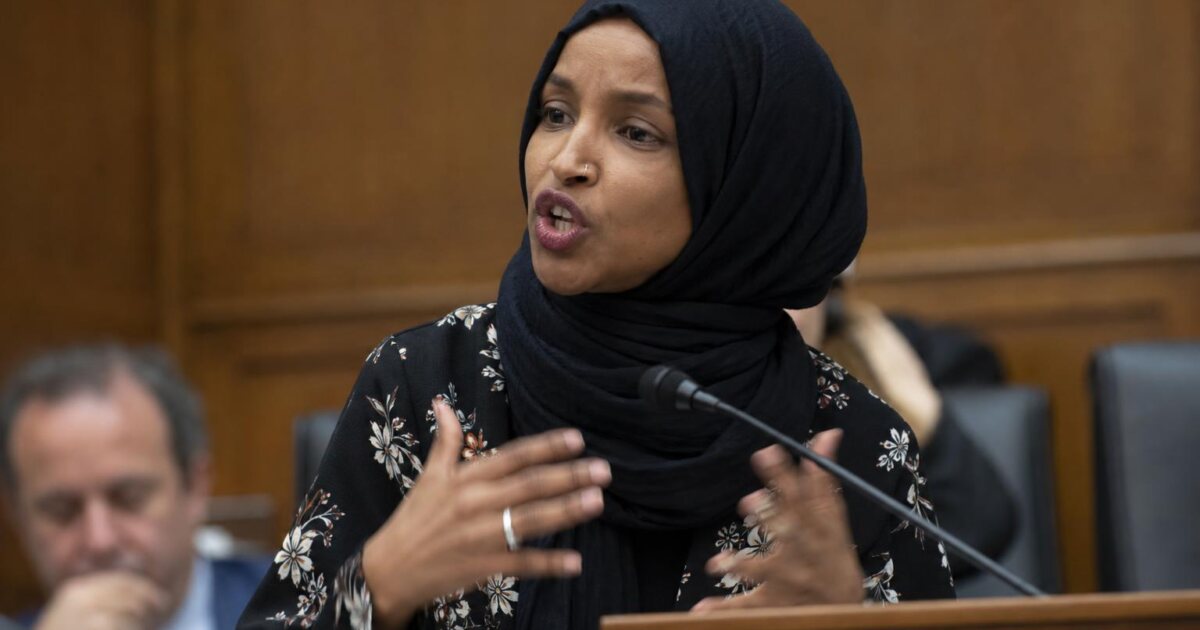
Defenders of Rep. Ilhan Omar are claiming that she was “targeted by President Trump” over her political opposition to him and his administration. But that’s just a lazy response from Democrats, and besides, it’s looking more like there’s a fire underneath all of this Omar smoke.
Homeland Security Secretary Markwayne Mullin revealed that federal agents executed multiple search warrants on the same day investigators searched Rep. Ilhan Omar’s Washington, D.C., home, offering the clearest indication yet that the criminal investigation extends beyond the Minnesota Democrat’s residence.
Speaking Friday on “The Charlie Kirk Show,” Mullin said Omar’s home was not the only location targeted by Homeland Security Investigations agents during Monday’s operation.
“She wasn’t – or it wasn’t the only place we served the warrant. There was multiple other warrants served on that same day,” the secretary said. “We had a judge sign it, and we expect to be able to take the case to a grand jury.”
Mullin did not identify the locations searched under the additional warrants, the people connected to them or precisely what investigators were seeking, leaving significant questions about the scope of the expanding federal investigation.
The DHS secretary also said the searches were authorized by a federal judge and that investigators expect to present evidence to a grand jury.
Mullin described the investigation as a “strong case” and rejected Omar’s accusations that the Trump administration is using federal law enforcement to target one of the president’s most outspoken political opponents.
Omar has not been charged with a crime, and the issuance of search warrants means a judge found probable cause for the searches but does not establish that Omar or anyone else committed a criminal offense.
The investigation centers in part on whether Omar or members of her family made false statements in immigration paperwork connected to their entry into the United States as refugees during the 1990s or Omar’s subsequent naturalization.
Reuters reported that the sealed warrant for Omar’s home listed conspiracy, immigration fraud and false statements on immigration paperwork among the potential crimes under investigation.
Omar was born in Somalia, spent several years in a refugee camp in Kenya after her family fled the country’s civil war and arrived in the United States in 1995 at age 12 before becoming a naturalized citizen in 2000.
Federal agents searched her Washington residence before dawn Monday and seized her personal cellphone, while prosecutors have also issued more than a dozen grand jury subpoenas, including subpoenas involving some of Omar’s relatives.
One of Omar’s sisters voluntarily spoke with federal investigators, Reuters reported, although authorities have not publicly disclosed what she discussed with agents.
Mullin also raised the possibility that coordinated immigration fraud could, depending on the evidence, potentially be investigated under the federal Racketeer Influenced and Corrupt Organizations Act.
His comments did not establish that prosecutors are pursuing RICO charges against Omar or anyone connected to the investigation, and no such charges have been publicly announced.
The investigation may carry particularly serious consequences because federal authorities are examining whether grounds exist to challenge Omar’s citizenship, with one person familiar with the investigation telling Reuters that possible denaturalization and deportation are among the potential outcomes being considered.
Naturalized Americans can lose citizenship if the government proves in court that citizenship was unlawfully obtained or secured through concealment or willful misrepresentation of material facts.
Omar has categorically denied wrongdoing and described the investigation and search as an effort by the Trump administration to intimidate a political opponent weeks before she faces voters in the November 3 midterms.
Her attorneys escalated that fight Friday by demanding the return of property seized from her residence and accusing federal investigators of violating safeguards imposed by the magistrate judge to protect constitutionally privileged congressional material.
The Justice Department rejected those accusations, saying its attorneys and law-enforcement partners complied with the court’s orders and legal obligations.
The timing has also drawn scrutiny because the Justice Department has traditionally avoided overt investigative actions involving political candidates close to elections when those actions could affect a race, although the policy is an internal practice rather than a legal prohibition.
Trump has denied directing the investigation, saying after the search that he understood authorities were examining Omar but that the matter was “really up to the DOJ.”
Mullin’s disclosure about additional warrants now adds a significant new element to the case, suggesting investigators were simultaneously pursuing evidence at multiple locations rather than limiting Monday’s operation to Omar’s Washington home.
Exactly who or what was targeted by those additional warrants remains undisclosed, but Mullin’s comments indicate investigators believe the evidence gathered could eventually be placed before a federal grand jury.