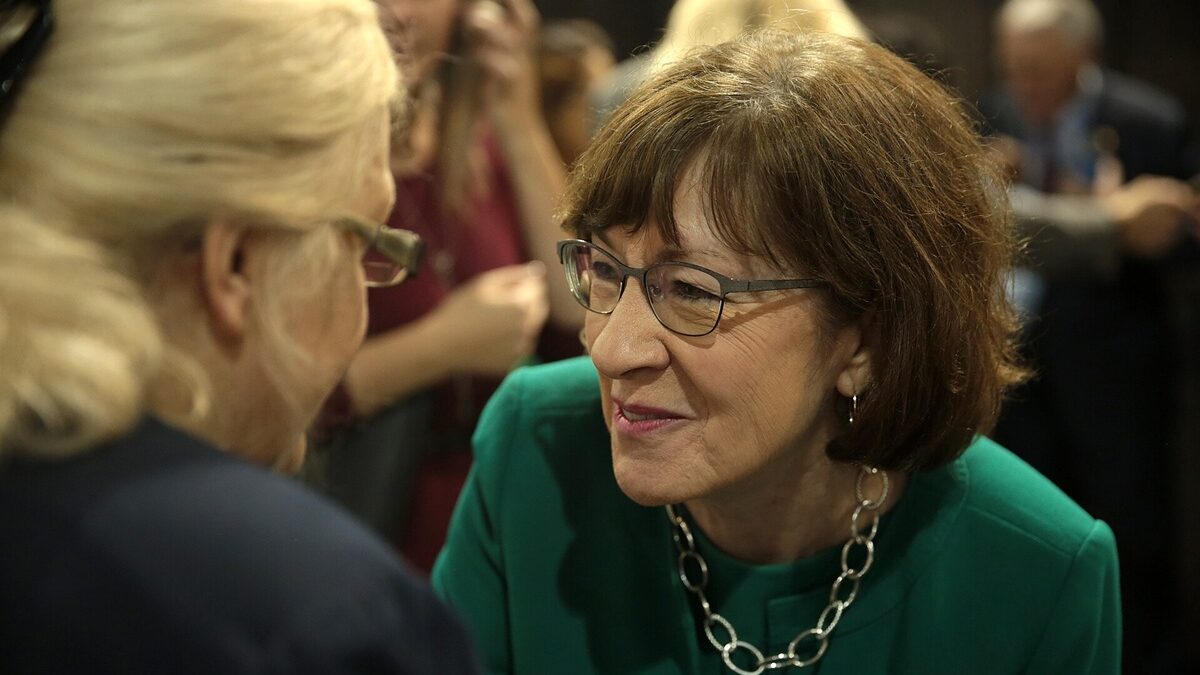
As we race toward election day next month, Democrat chances of retaking Congress are looking slimmer and slimmer, especially when it comes to must-win races involving supposedly ‘vulnerable’ Republicans.
Republican Sen. Susan Collins remains in a competitive reelection contest in Maine, according to a new poll showing the five-term incumbent trailing Democratic challenger Troy Jackson by just two percentage points with less than three weeks remaining before the November midterm elections.
The Suffolk University survey, released Wednesday, found Jackson receiving 49% support among likely voters compared with 47% for Collins. But the two-point difference falls well within the poll’s 4.4-percentage-point margin of error, indicating that neither candidate holds a statistically significant advantage.
And the polling sample was exceedingly smalle: The survey only questioned 500 likely Maine voters between October 8 and October 11. Collins, who is seeking a sixth term, is the only Republican senator running for reelection this year in a state that supported former Vice President Kamala Harris in the 2024 presidential election.
Despite Maine’s Democratic lean in recent presidential contests, Collins has repeatedly attracted support from independent voters and Democrats, allowing her to maintain her Senate seat since 1997. David Paleologos, director of Suffolk University’s Political Research Center, suggested that Collins’ reputation as a moderate and her seniority in Washington could be helping her retain support.
He also pointed to dissatisfaction among some Democratic voters following the withdrawal of Graham Platner, who had initially secured the party’s Senate nomination.
“Either through her seniority as senator, her branding as a moderate, or possibly from disgruntled Graham Platner voters who were forced to relinquish his Democratic Party nomination, somehow Collins is starting to erode the Democratic base of Jackson just enough to keep the race close,” Paleologos said.
Jackson, a former president of the Maine Senate, became the Democratic nominee after Platner withdrew from the race in July following a series of controversies. The change disrupted what had already become one of the country’s most closely watched Senate campaigns.
Collins has emphasized her experience, bipartisan legislative record and ability to secure federal funding for Maine. As chairwoman of the Senate Appropriations Committee, she has highlighted her role in directing federal resources toward infrastructure, healthcare and other state priorities.
Other polling has shown Collins with a narrow advantage. A September New York Times/Siena College survey placed the Republican senator ahead 49% to 46%. The varying results illustrate the uncertainty surrounding the race, particularly given Collins’ history of performing better than some preelection surveys suggested.
Either way, it’s probably best for Chuck Schumer to hold off on the Senate majority leader’s parking spot.