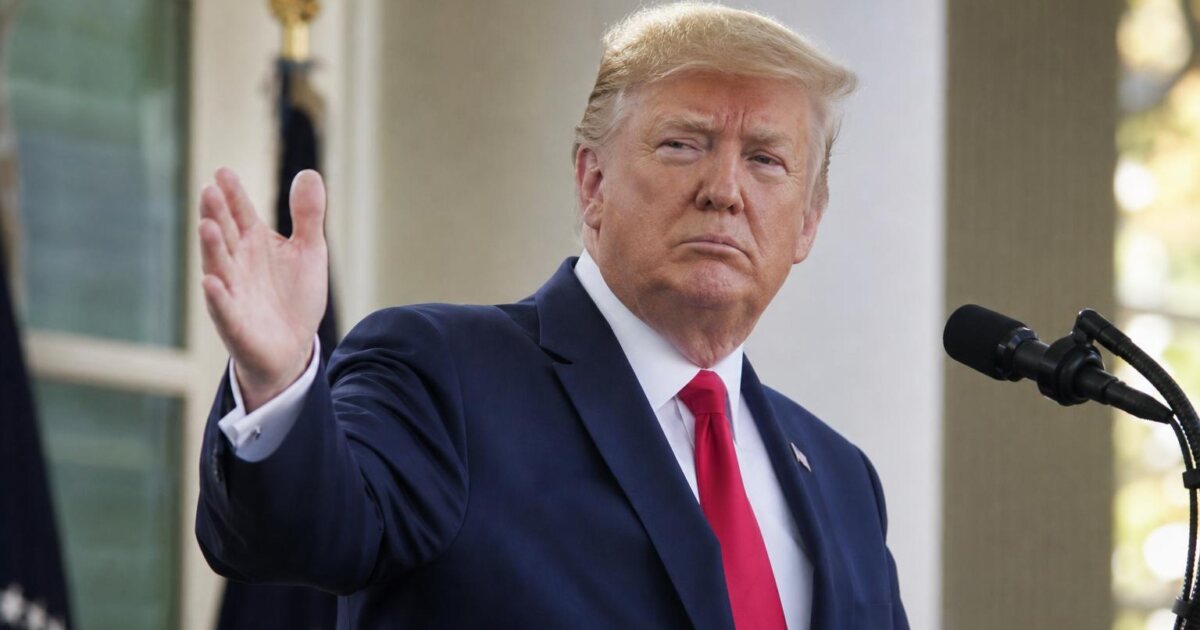
President Donald Trump has tapped Director of National Intelligence Jay Clayton to lead a newly created White House task force charged with examining the risks and opportunities presented by artificial intelligence and recommending how the federal government should respond.
Trump announced Sunday that Clayton will chair the “Super Intelligence Force,” formalizing an appointment that Clayton had confirmed in an interview with The Wall Street Journal. “The president asked that a group be put together that was going to ensure exactly what he said,” Clayton told the Journal, “that we stay the leaders in superintelligence, and that the interests of the American people are put first.”
“These are all serious people who have addressed opportunities and risks in the past,” Clayton said, “and are committed to doing this so that America wins the SI race and we win it through the benefit of the American people.”
The appointment effectively makes Clayton the administration’s top coordinator on artificial intelligence policy while he continues serving as director of national intelligence. The new task force has been given 120 days to assess the opportunities and potential dangers associated with rapidly advancing AI technology and examine what role the federal government should play.

The panel will also review existing government systems for receiving warnings about AI-related security incidents, including hacks, breaches and so-called jailbreaks that circumvent safeguards built into AI models. According to the task force’s charter, it will recommend ways to improve the government’s ability to respond to those incidents using existing federal authority.
It will also “develop plans for responding to SI-enabled threats to our society, while preventing overregulation and regulatory capture that would stifle innovation and competition,” according to the charter language reported by the Journal. “SI” refers to “Super Intelligence,” the terminology Trump has ordered executive agencies to use instead of “artificial intelligence” or “AI.”
Trump signed an executive order Sept. 29 directing federal departments and agencies to adopt the new terminology in official communications, websites, reports and other non-statutory documents. The underlying statutory definition of artificial intelligence remains unchanged. Clayton said remaining ahead of America’s foreign competitors will be a central concern of the new panel.
“The risk of not being first is high,” Clayton said. “Not being first increases the identified, and unidentified, risks, particularly from our adversaries. Being first will better enable us to address those risks on behalf of the American people.”
The task force brings together some of the administration’s most senior officials. Vice President JD Vance, Defense Secretary Pete Hegseth, Treasury Secretary Scott Bessent and White House Chief of Staff Susie Wiles are among its members. Federal Trade Commission Chairman Andrew Ferguson will serve as one of three vice chairs.
The other vice chairs are Emil Michael, the Pentagon’s undersecretary for research and engineering, and Office of Personnel Management Director Scott Kupor. Each will oversee a different area of the panel’s work. Michael will coordinate with AI companies, while Kupor will work with critical-infrastructure operators and other industries.
Ferguson will oversee outreach involving consumers and organizations concerned with issues including privacy, children, religious liberty, free speech and freedom of association. The group will report to Trump and Wiles.
The administration is also bringing in prominent outside advisers. Former Secretary of State Condoleezza Rice will advise the group on national-security matters, while venture capitalist David Sacks, Trump’s former AI czar and co-chair of the President’s Council of Advisors on Science and Technology, will also participate.
Sacks had previously served as the administration’s leading official coordinating AI-related policy, making Clayton the second official during Trump’s current term to receive a government-wide coordinating role over the technology.
The new task force follows a White House meeting with executives from major technology companies, including OpenAI President Greg Brockman, Anthropic CEO Dario Amodei and Nvidia CEO Jensen Huang.
Companies participating in the meeting agreed to voluntary principles covering AI safety, including internal monitoring of model development, independent evaluations and notifications to corporate boards about safety efforts.
Trump has resisted broad federal regulation of the industry, arguing that excessive restrictions could slow American development and give China an advantage. “I will never stifle the growth of technology that will be bigger than the Industrial Revolution,” Trump said Tuesday.