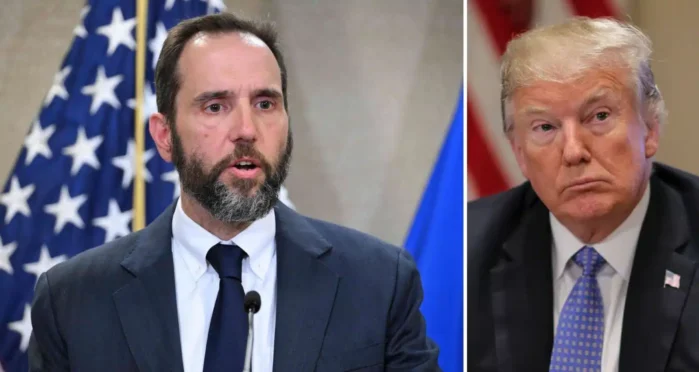
If anyone deserves to be put on trial for gross violations of trust, the Constitution, and the law, its Joe Biden’s anti-Trump attack dog Jack Smith.
Former special counsel Smith’s investigation into President Trump obtained communications involving nearly 50 journalists from major news organizations, according to newly released whistleblower disclosures that are raising questions about government access to reporters’ interactions with confidential sources.
The records included communications involving journalists from Fox News, CNN, CBS News, NBC News, CNBC, The Wall Street Journal, The Washington Post, Bloomberg, The Associated Press, Reuters, NPR, the Los Angeles Times, The Washington Times and The Federalist.
The disclosures were released by Senate Judiciary Committee Chairman Chuck Grassley, R-Iowa, as Smith appeared before the committee Tuesday to defend his handling of the investigation known as “Arctic Frost.”

Among the journalists whose communications were reportedly included was Mollie Hemingway, editor-in-chief of The Federalist. “I’m sickened by this news that my journalistic communications were obtained as part of Jack Smith’s egregious misconduct,” Hemingway wrote following the disclosure.
Federalist CEO and co-founder Sean Davis went further, accusing Smith of “spying” on the publication and saying the organization was trying to determine how many of its reporters had communications collected. “We are still working to determine which of our reporters were targeted by Jack Smith and which journalistic communications he and his thugs seized,” Davis said.
The newly disclosed records, however, indicate that investigators obtained the reporters’ communications indirectly rather than by subpoenaing their personal phones or accounts. Smith’s prosecutors issued a June 2023 subpoena to the National Archives and Records Administration seeking records associated with 87 phones used by officials in Trump’s first White House.
The material produced by the National Archives included communications between those government officials and journalists. That distinction means descriptions of the operation as Smith directly “spying on” or targeting individual reporters go beyond what has so far been established by the released records.
The communications were nevertheless placed in the possession of federal investigators conducting a criminal investigation, raising concerns about the confidentiality of reporters’ interactions with government sources.
Grassley sharply criticized the scope of the collection. “What will the partisan media say about this disgraceful government overreach?” Grassley said.
The journalist records are the latest disclosure involving the breadth of Arctic Frost, the investigation examining Trump’s efforts to remain in office following the 2020 presidential election and events surrounding Jan. 6, 2021.
Congressional Republicans previously revealed that investigators obtained phone records associated with more than a dozen Republican lawmakers.
Investigators also obtained text messages involving 44 members of Congress that were contained in records produced by executive branch officials, according to a House Judiciary Committee investigation.
House Republicans contend some of those communications were protected by the Constitution’s Speech or Debate Clause and have accused Smith’s office of violating Justice Department procedures. Those conclusions remain disputed and have not been established by a court.
Smith defended his investigative decisions during Tuesday’s contentious Senate Judiciary Committee hearing. He said obtaining lawmakers’ phone records was necessary to establish the timeline and intent surrounding Trump’s efforts to challenge the 2020 election results.
Smith emphasized that the phone records obtained directly from telecommunications companies were metadata rather than the content of lawmakers’ conversations.
“They show who a call was to, who a call was from and the length of that call,” Smith said. Asked whether his investigation had wiretapped members of Congress, Smith answered, “No.”
Grassley also disclosed that investigators obtained financial information associated with thousands of Trump donors. According to protected disclosures provided to his committee, Smith’s investigation obtained at least 4,782 checks written by donors to Republican organizations, including some donations worth as little as $5 or $10.
The disclosure involving journalists presents a separate concern because reporters frequently communicate privately with government officials while developing stories, sometimes under agreements protecting the source’s identity.
Federal policy generally provides special protections when investigators deliberately seek journalists’ records because of the potential effect on newsgathering and confidential sources.
The circumstances disclosed this week are different because the reporters’ communications appear to have been collected as part of records belonging to Trump administration officials rather than through warrants or subpoenas directed at the journalists themselves.