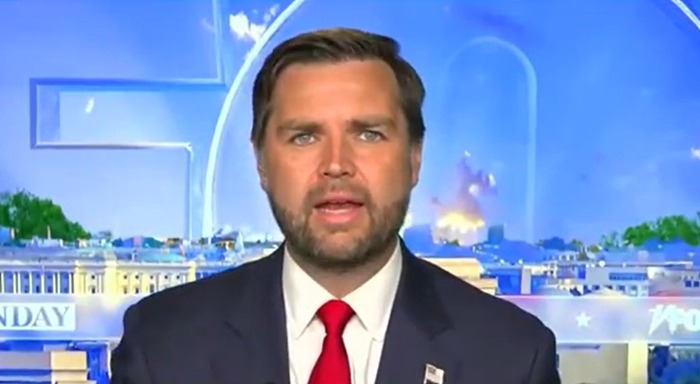
Vice President JD Vance delivered a blunt message to his own party this week that deserves to be read carefully by every Republican strategist who thinks calling Abdul El-Sayed a communist is a sufficient substitute for an economic agenda: “If we don’t get this right, don’t blame young people for being sympathetic to socialism. We’ve got to blame ourselves.”
That’s the VP of the United States telling his own party that the DSA’s rise isn’t entirely the left’s fault — and he’s right to say it.
“Our response to socialism, which is a dangerous and destructive ideology that’s been tried in the past and failed, our response to that can’t be just to ignore the economic concerns that I think are feeding this rising interest in socialism,” Vance said. “You don’t stop socialism by throwing slogans at people about the free market. You stop socialism by making people’s lives better.”
WATCH:
.@VP: "My warning to my fellow Republicans would be if we don't get this right, don't blame young people for being sympathetic to socialism. We've got to blame ourselves. I think what is so unique and refreshing about Donald Trump's economic policy is that it is not the same old… pic.twitter.com/PMTZ4NuXzk
— Rapid Response 47 (@RapidResponse47) August 13, 2026
This is a harder truth than most Republicans want to hear in a week when they’re busy dunking on Mamdani’s grocery store collapse and El-Sayed’s deleted YouTube videos. Both of those things are fun. Neither of them is a governing vision.
Vance named the specific failures that socialist messaging is exploiting: housing prices that doubled under Biden, interest rates that made homeownership impossible for an entire generation, a hollowed-out industrial base that left working-class communities without good jobs, and an educational-industrial complex that sent millions of young people to college at catastrophic cost for credentials that don’t pay off.
He then pointed to Trump’s economic results: trillions in new investment, manufacturing jobs returning, housing prices finally stabilizing, 83,000 construction workers building factories at historic levels, record-low unemployment claims. These are real accomplishments. They need to be communicated relentlessly — not just as political talking points but as proof that the free market, properly structured and defended against the distortions of globalism and financialization, actually delivers what it promises.
Let’s be clear: The economic problems of the last 25 years were not produced by too much free market. They were produced by crony capitalism, globalist trade policy that prioritized cheap goods over American workers, Federal Reserve policy that inflated asset prices while crushing savers, and regulatory regimes that protected incumbent industries against competition. Milton Friedman and Thomas Sowell didn’t produce those outcomes. The bipartisan Washington consensus did.
The correct Republican answer is not to abandon free market principles. It’s to clearly distinguish between free markets — which produce broad prosperity when they actually function — and the managed capitalism that both parties have practiced for decades, which produced the conditions that gave rise to Mamdani and El-Sayed.
Vance is right that slogans aren’t enough. The answer isn’t abandoning the principle. It’s living up to it — actually and visibly — while making sure voters understand who created the problem Republicans are now trying to fix.